
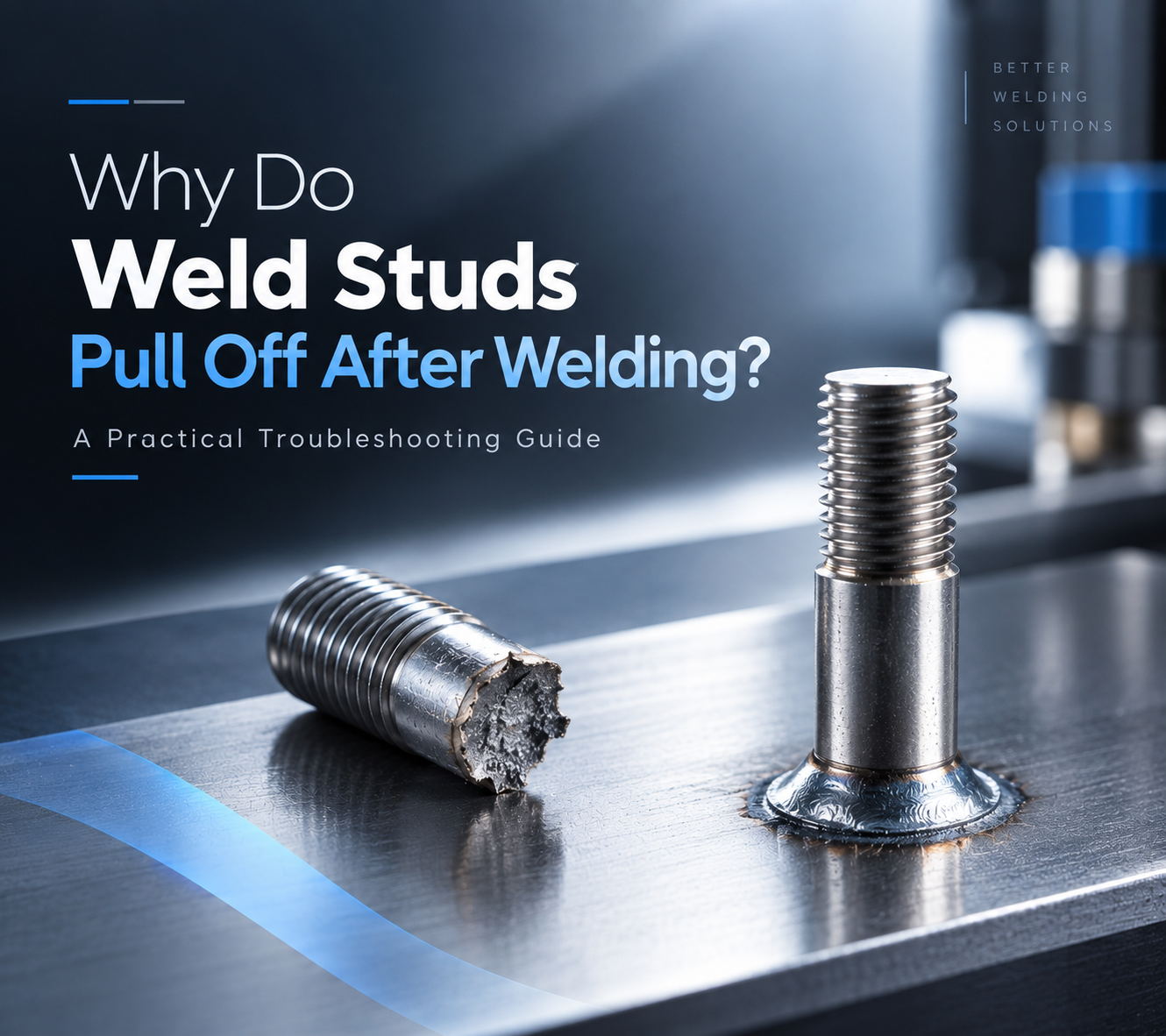
2026-09-30
The weld cycle is complete. The stud looks properly welded, and the welding system shows no obvious alarm. Then, during assembly or a pull test, the weld stud breaks away from the workpiece. For engineers responsible for welding quality, this is a familiar but frustrating situation. The first reaction is often to increase the welding current or extend the weld time. Sometimes that changes the result. But if the actual cause lies in stud positioning, grounding, surface condition, feeding stability, or process repeatability, changing the welding parameters alone may only move the problem from one place to another. A more reliable approach is to look at the complete welding process and determine where the weld started to lose stability. 02|Start With the Failed Weld Before changing any welding parameters, start with the failed weld itself. The fracture surface can provide useful evidence about how the weld was formed. Little visible fusion may point toward insufficient heat input or unstable arc conditions. Uneven fusion around the stud may indicate problems with gun alignment, stud positioning, grounding, or surface condition. It is also important to distinguish between a stud that never achieved sufficient fusion and one that formed a weld but later failed under mechanical loading. These two situations may look similar from the outside, but they require different troubleshooting approaches. Cross-section analysis can reveal the difference between proper fusion, partial fusion, and lack of fusion in stud welding. The first question should therefore be: What does the failed weld tell us about how the weld was formed? Observed Condition Possible Direction of Investigation Little or no visible fusion Welding current, weld time, lift height, arc stability Uneven fusion around the stud Gun alignment, stud positioning, grounding Excessive spatter Heat input, arc conditions, parameter combination Weld looks acceptable but stud pulls off…