
2026-08-06
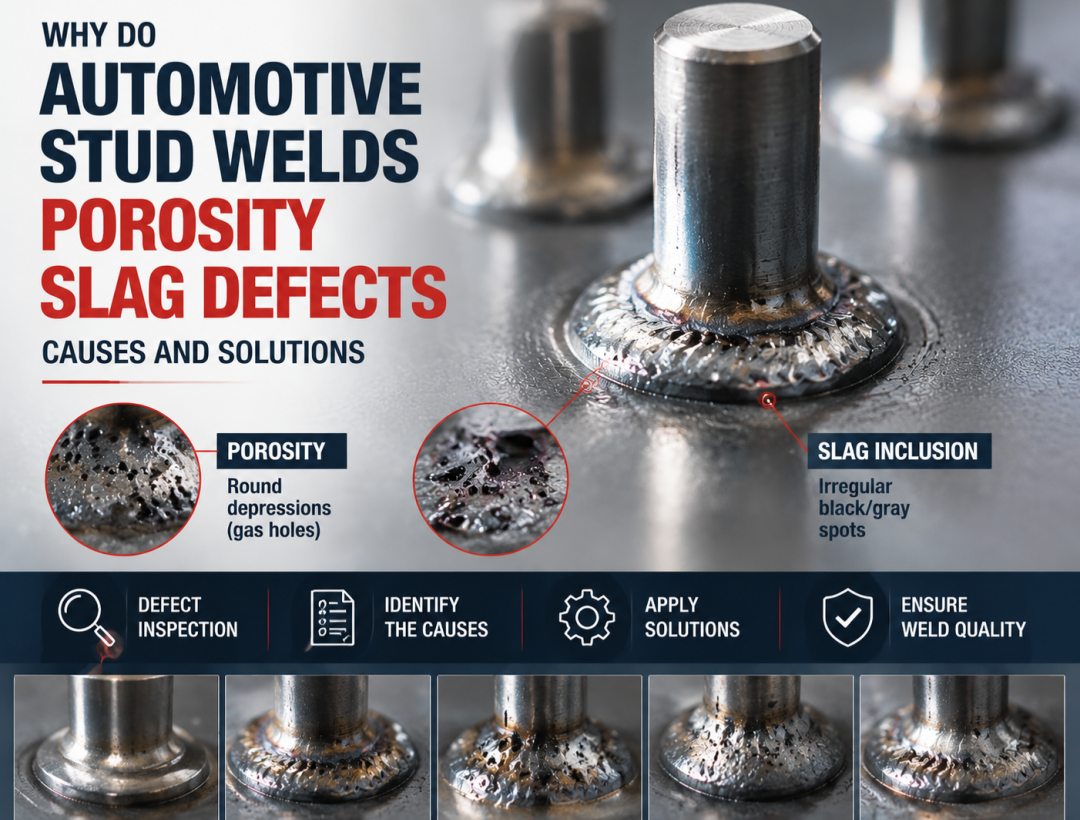
Introduction In automotive Body-in-White (BIW), automotive components, and new energy vehicle structural manufacturing, stud welding is widely used for applications such as cable harness fixing, heat shield installation, interior component mounting, and structural part assembly. However, in actual production, issues such as poor weld integrity, porosity, slag inclusion, and incomplete fusion remain key factors affecting stud welding quality stability. In severe cases, these defects can reduce stud strength and even cause stud detachment, affecting downstream assembly processes and product reliability. Based on stud welding principles and practical industrial applications, this article systematically analyzes the formation mechanisms, major causes, and engineering solutions for porosity and slag inclusion defects. 1. Formation Mechanism of Porosity and Slag Inclusion 1.1 Porosity Formation Mechanism: During the stud welding process, the high-temperature arc rapidly melts the welding area and forms a weld pool. If gases (such as H₂, CO, and N₂) inside the weld pool cannot escape before the molten metal solidifies, they will remain trapped inside the weld and form porosity. Porosity is mainly classified into: Surface porosity Internal porosity Among them, internal porosity is more difficult to detect and can reduce the effective strength of the welded joint. 1.2 Slag Inclusion Formation Mechanism: Slag inclusion refers to non-metallic impurities generated during the welding process that fail to escape in time and remain trapped inside the weld after solidification, forming defects. The main sources include: Oxides on the base material surface Oil contamination and foreign materials Coating residues Oxidation products generated during the welding process Slag inclusion reduces the effective bonding area of the weld and creates stress concentration areas, affecting weld joint reliability. 2. Six Root Causes of Porosity and Slag Inclusion 2.1 Workpiece Surface Contamination — The Most Common Cause Insufficient cleaning before welding is the primary cause of porosity and slag inclusion….