

AI Vision Empowers Spot Welding Quality for BIW E‑series Electrode Cap Dress Inspection System by Hongbai Tech In modern intelligent manufacturing, especially on automotive Body-in-White (BIW) welding production lines, resistance spot welding is widely used as an efficient and reliable joining process for high-strength steel, aluminum alloy and other materials. Its welding quality directly determines the safety, durability and structural strength of the entire vehicle. Among the key factors influencing spot welding quality, electrode cap dressing quality is often underestimated yet critical. It determines current conduction efficiency, contact stability, weld nugget size, spatter control and electrode service life.
With the deep integration of Industry 4.0 and artificial intelligence, traditional maintenance methods relying on manual visual inspection or fixed-interval replacement can no longer meet the requirements of high-cycle, high-quality and intelligent production. In response, Shenzhen Hongbai Technology Industrial Co., Ltd. has launched the E-series AI Vision Electrode Cap Dress Inspection Sensor System. With high-precision imaging, real-time defect identification and closed-loop feedback, it has become core equipment to ensure the stability of spot welding processes.
This paper analyzes the importance of electrode cap dressing, the principles and functions of the AI vision inspection system, and explains how it improves the consistency and reliability of spot welding nuggets by enhancing dressing quality.
https://www.hongbaiweld.com/all-product/robot-series/daytime-running-lights2677.html
Core Influence of Electrode Cap Dressing Quality on Spot Welding Performance
As the key medium for current transmission, the end-face condition of the electrode cap directly affects the physical behavior of welding:
Contact Area and Current Density: Pits, copper adhesion, eccentricity and other defects lead to abnormal current density, resulting in insufficient nugget, spatter or burn-through.
Thermal Resistance and Heat Dissipation: Contamination or oxide layers increase contact resistance, reduce heat transfer efficiency and accelerate electrode aging.
Mechanical Alignment and Pressure Consistency: Out-of-round, inclined or uneven end faces cause uneven force, poor indentation or false welding.
Dressing Cycle and Electrode Life: Traditional experience-based management easily causes over-dressing or delayed dressing, shortening service life or causing quality risks.
Traditional methods lack objectivity and timeliness, so automated and intelligent detection is urgently needed.
Architecture and Core Technologies of the AI Vision System
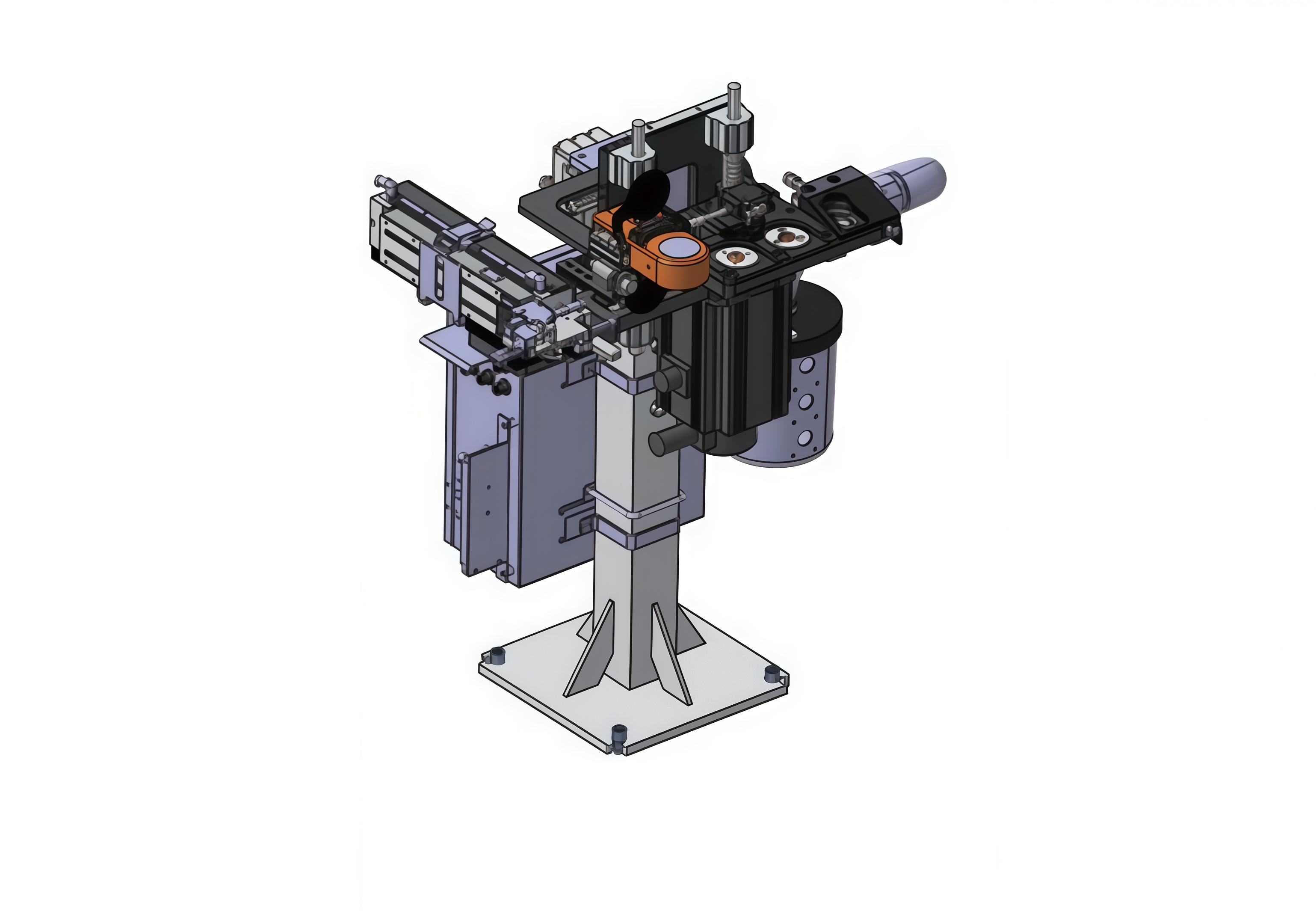
Hongbai E-series system (typical model HBRAV-02-E8-1) integrates optical imaging, edge computing and deep learning to form a closed-loop monitoring system.
1.System Architecture
AI vision sensor: 6.3MP high-resolution industrial camera, ring light source, IP67 protection IPC with GPU acceleration running dedicated AI vision inspection software GigE Vision communication module and PLC control system for robot, welder and dresser linkage Air cleaning device with dust removal air knife to ensure stable imaging Up to 12 sensors connectable to one IPC for multi-station global monitoring.
2.Hardware Performance
Resolution: 3072 × 2048
Pixel accuracy: 0.012 mm/Px
Field of view: φ19 mm
Working distance: 4–13 mm
Protection class: IP67
Operating temperature: 0–60℃
High resolution enables reliable detection of micro-defects smaller than 0.1 mm.
3.AI-driven Intelligent Detection Algorithm
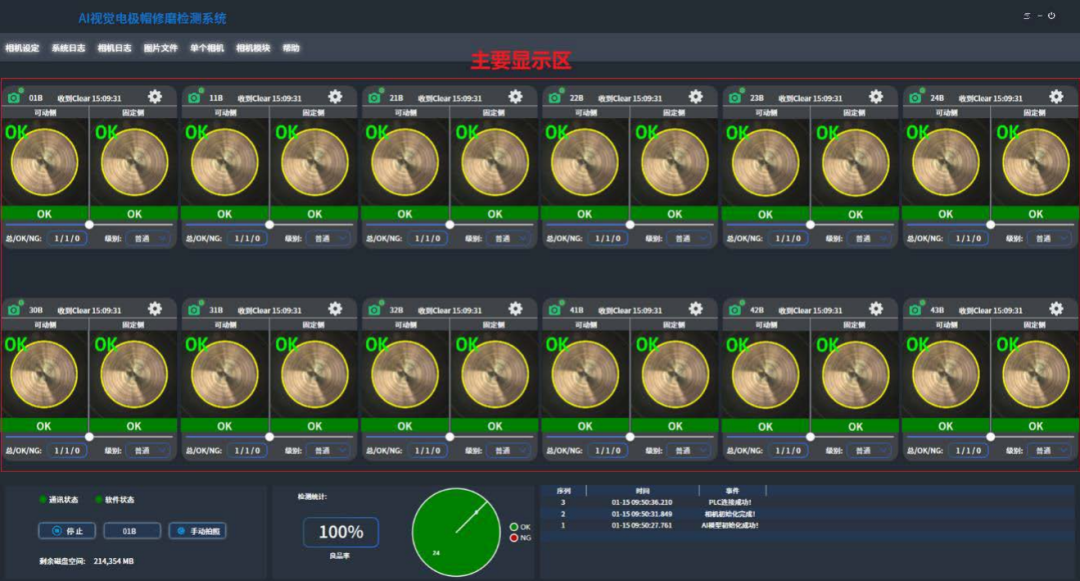
Based on CNN deep learning model, the system identifies 10 typical dressing defects:
Black mark, Protrusion, Copper adhesion, Pit, Radial lines, Over-size/Under-size, Out-of-round, Eccentricity, Plum pattern, Incomplete dressing.
How the AI System Improves Spot Welding Quality
1.Standardization and Traceability
The system replaces manual experience with digital parameters, realizing quantitative monitoring of diameter, roundness, concentricity and cleanliness. It supports data logging and trend analysis for predictive maintenance and full-process traceability.
2.Reducing Welding Defects
More than 30% of spot welding defects are caused by abnormal electrode conditions. The system effectively prevents insufficient nugget, false welding, spatter, burn-through and poor indentation, greatly improving weld consistency and reliability.
3.Closed-Loop Process Optimization and Intelligent Decision-Making
Integration with MES system:Inspection results can be uploaded to the Manufacturing Execution System via OPC UA or Modbus TCP, enabling full lifecycle traceability of quality data.
Participation in SPC statistical process control:Indicators such as NG rate and average defect area are incorporated into control chart analysis to detect process drift in a timely manner.
Assistance with robot path calibration:Frequent end-face eccentricity may indicate robot positioning deviation, and the system can provide collaborative calibration suggestions.
Support for remote operation and expert diagnosis:Historical images and logs can be accessed through the RAIDI platform, allowing engineers to troubleshoot remotely and reduce downtime.
Application Case and Benefits
A leading new energy vehicle manufacturer deployed 18 sets of E-series systems on key BIW welding lines.
The results are remarkable: Electrode cap life: increased from 1,800 spots to 2,400 spots (↑33.3%)
Rework rate caused by electrode issues: decreased from 2.7% to 0.4% (↓85.2%)
Peeling test pass rate: increased from 93.5% to 98.9% (↑5.4%)
Monthly unplanned downtime: reduced from 16.5 hours to 6.2 hours (↓62.4%)
The system improves traceability and efficiency of root cause analysis.
Future Outlook
The system will evolve toward a fully autonomous closed-loop system of prediction-intervention-self-healing:
Multimodal sensing fusion: Integrate force sensors and temperature sensors to construct a comprehensive evaluation model for equipment health status.
Online parameter adaptive adjustment: When slight dressing deviations are detected, automatically fine-tune welding current or pressure for compensation.
Federated learning for cross-factory collaborative optimization: Multiple factories share anonymized defect samples to continuously iterate and improve the generalization ability of the AI model.
Digital twin integration: Map electrode status to the virtual production line to achieve full-factor simulation and prediction.
AI will upgrade from a quality inspector to the intelligent brain of spot welding.
Although small in size, the electrode cap is critical to spot welding quality. Hongbai E-series AI Vision Electrode Cap Dress Inspection System achieves the transformation from experience-based to data-driven, from passive repair to active prevention. It is a key solution to improve the accuracy, reliability and intelligence of BIW spot welding, laying a solid foundation for automotive intelligent manufacturing.