
2025-12-20
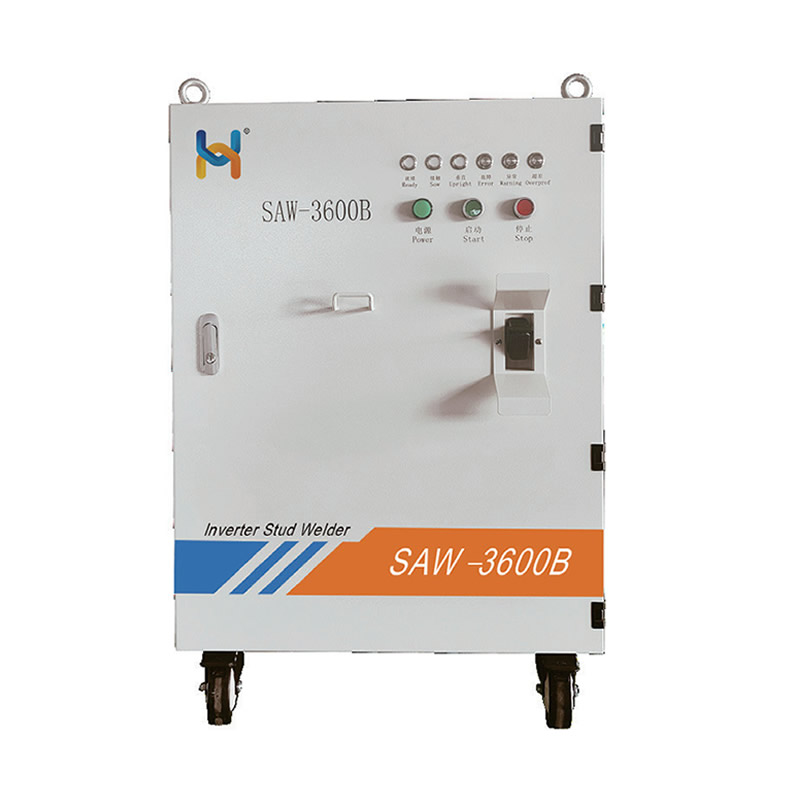
SAW-3600B stud welder combines DSP+FPGA architecture, 20kHz inverter and linear servo drive with AQC2 active quality control for consistent welds. Supports Weld NLC group control and USB/Ethernet data.
2026-10-16
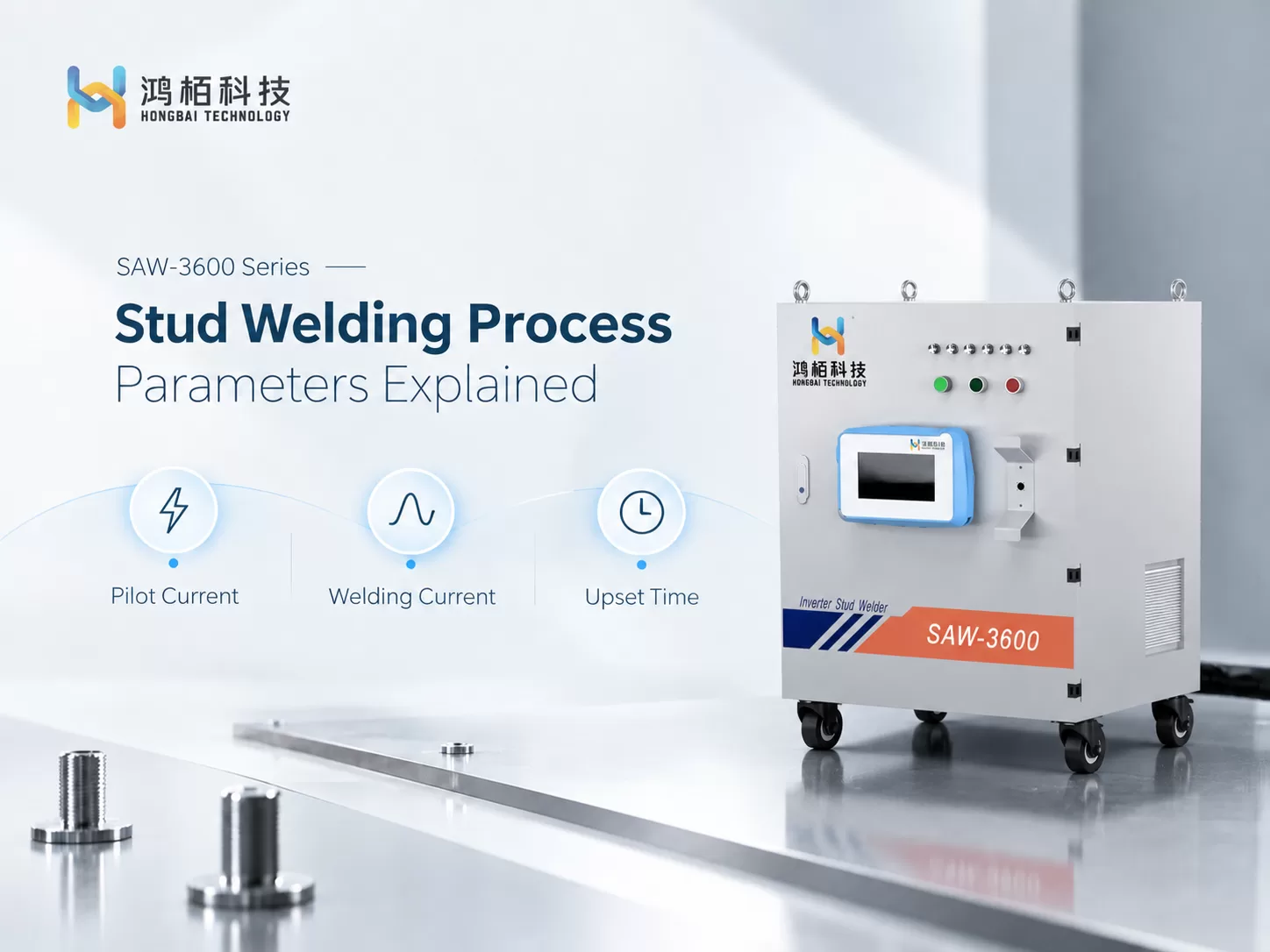
Hongbai Technology Technical Column | Professional Series Introduction In stud welding, a small change in current or welding time can make a noticeable difference to the final weld. Too little energy may result in incomplete fusion, while excessive heat can cause spatter, an irregular weld collar, or burn-through on thin sheet metal. On Hongbai Technology’s SAW-3600 series stud welding system, parameters such as pilot current, welding current, and upset time are used to configure the welding cycle. Getting the best result is not simply a matter of increasing the current. The stud, base material, surface condition, lift height, and welding gun movement all need to be considered together. This article looks at how these parameters work, the reference settings available on the equipment, and what to consider when adjusting them for different applications. 1. How the Stud Welding Cycle Works In the servo-controlled welding process described here, the electrical output and the mechanical movement of the stud work together through four stages. Stage 1: Initial contact The stud is positioned against the workpiece, creating the electrical contact required to initiate the welding sequence. Consistent positioning and stable contact help establish repeatable starting conditions. Stage 2: Pilot arc The power source applies the pilot current while the servo welding gun lifts the stud away from the workpiece. This establishes the pilot arc before the main welding stage begins. The pilot stage helps initiate the arc and prepare for the main welding cycle. On coated or contaminated surfaces, the results also depend on the coating, surface cleanliness, and the selected current and time. Stage 3: Main welding arc When the stud reaches the preset lift height, the power source delivers the main welding current for the programmed duration. The arc melts the end of the stud and the corresponding area of the…
2026-09-01
1. Stud Welding in Sheet Metal Electrical Enclosure Manufacturing Stud welding is widely used for fastening applications in electrical enclosures, control cabinets, switchgear cabinets, distribution boxes, and other sheet metal structures. Compared with conventional nut welding, drilling and tapping, or mechanical fastening, stud welding allows a threaded stud or fastening element to be permanently attached directly to the sheet metal surface, reducing additional machining and assembly operations. Typical applications include grounding studs, mounting studs for circuit breakers and terminal blocks, busbar supports, cable management components, door hardware, and other internal cabinet components. In practical production, the selection of a sheet metal stud welding process depends mainly on sheet thickness, stud diameter, base material, required joint strength, surface condition, and the appearance requirements of the opposite side of the workpiece. For thin sheet metal electrical enclosures, minimizing distortion, discoloration, and visible marks on the reverse side can be particularly important. For structural components and grounding connections, weld strength and process consistency may take priority. Therefore, selecting stud welding equipment for electrical enclosures requires more than simply checking the welding current or stud diameter. The welding power source, stud welding gun, stud feeder, workholding system, and level of automation all need to be considered as part of the same process. 2. Capacitor Discharge and Drawn Arc Stud Welding 2.1 Capacitor Discharge Stud Welding Capacitor discharge (CD) stud welding stores electrical energy in capacitors and releases it over an extremely short welding cycle. Typical welding time is approximately 0.001–0.003 seconds, with peak current reaching approximately 5,000–10,000 A. Because the welding cycle is extremely short, heat input is concentrated around the weld area. This makes capacitor discharge stud welding particularly suitable for thin sheet metal and applications where backside appearance is important. Hongbai’s PFC Series capacitor discharge stud welding machines support stud diameters from…
2026-08-22
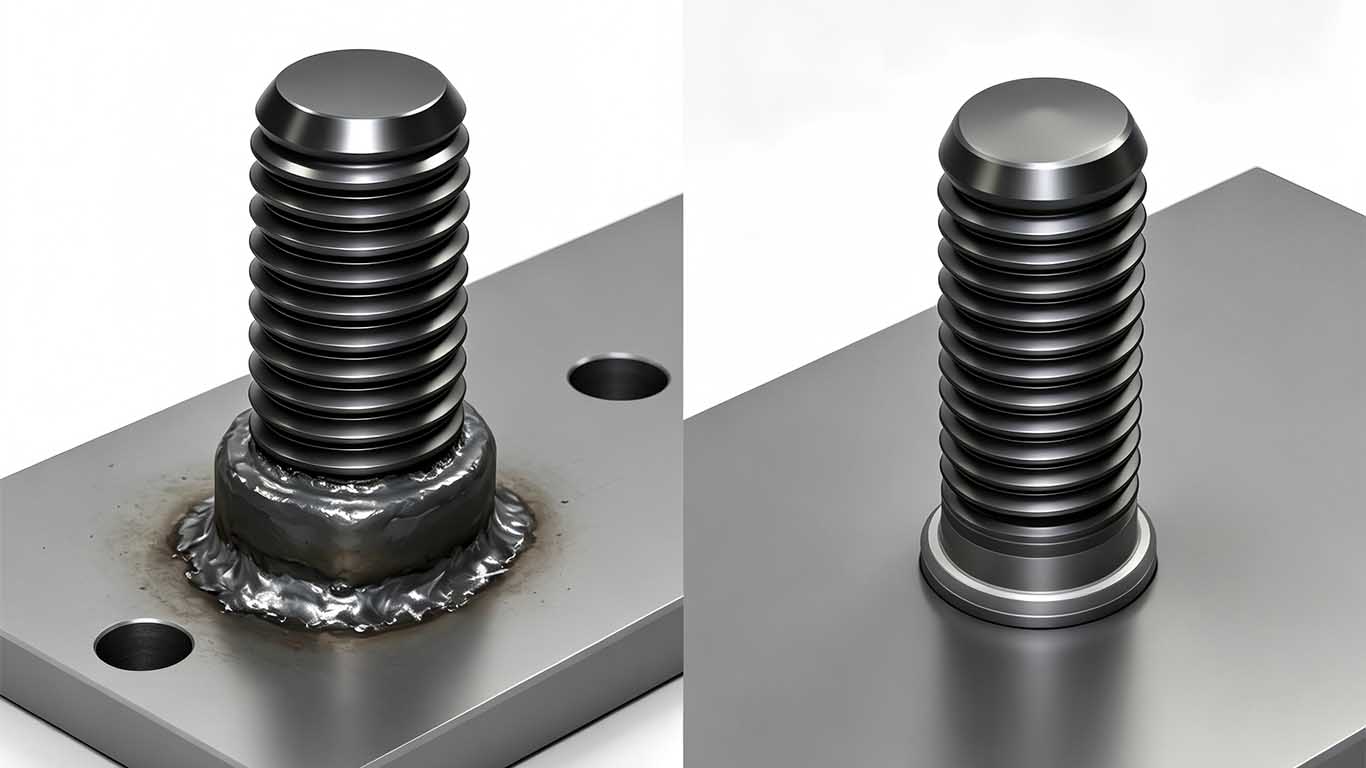
1. Start with the Application: How to Choose the Right Stud Welding Machine? As automotive manufacturing, sheet metal fabrication, appliance production, machinery manufacturing, and industrial automation continue to evolve, stud welding is moving from traditional manual operations toward automated, robotic, and digital production. For manufacturers, selecting a stud welding machine is no longer simply about comparing maximum welding current. Stud diameter, workpiece material, sheet thickness, required joint strength, production cycle time, and automation level all influence the final equipment selection. As a company specializing in intelligent welding equipment and industrial automation, Hongbai Technology has been developing stud welding technology since 2003. Its product portfolio covers capacitor discharge stud welding, short-cycle drawn arc welding, AC/DC stud welding, CNC automatic stud welding platforms, and robotic stud welding systems. Depending on the material, stud specification, and production method, Hongbai can provide complete solutions covering welding power sources, servo welding guns, automatic stud feeders, robots, and CNC platforms. Before selecting a machine, therefore, the first question should be: What type of stud welding process does your application actually require? 2. Choose the Welding Process Before Choosing the Machine Different stud welding processes operate differently and therefore have different requirements for the welding power source and welding gun. The two main processes used in industrial production are capacitor discharge stud welding and drawn arc stud welding. Capacitor discharge stud welding uses stored capacitor energy to complete the weld within an extremely short period, typically around 1–3 ms. This results in low heat input and minimal thermal impact on thin sheets. It is particularly suitable for small-diameter studs, typically 3–8 mm, thin sheet applications, and components where backside deformation must be minimized. Drawn arc stud welding, on the other hand, uses the welding gun to lift the stud and create an arc between the stud and…
2025-12-02
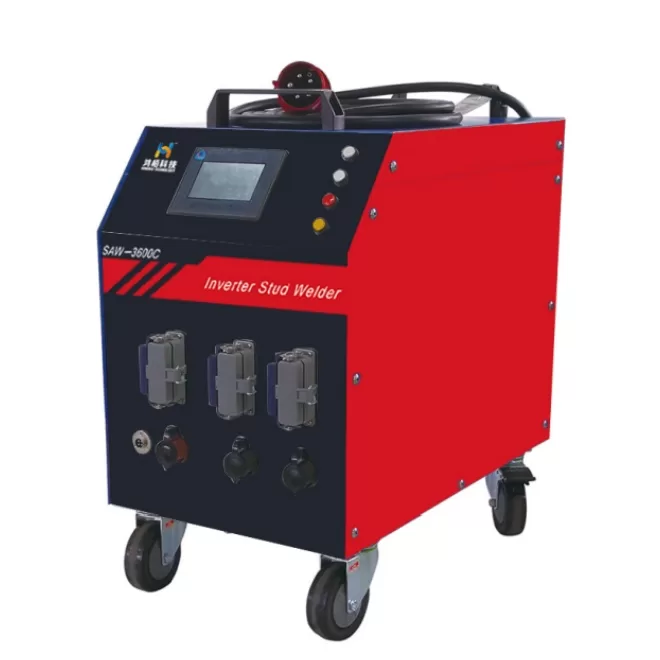
The SAW-3600C Drawn Arc Stud Welding Machine is a compact welding power source designed for industrial stud welding applications. With a maximum output current of 1,800 A and support for stud diameters from 3 mm to 12 mm, it is suitable for welding steel and galvanized steel studs. Featuring two independent welding channels, integrated linear servo motor drive and AQC2 Active Quality Control technology, the SAW-3600C provides a flexible and cost-effective solution for mold manufacturing, metal fabrication and other specialized welding applications. Key Features 1. Compact Design With a machine weight of only 65 kg and a compact cabinet structure, the SAW-3600C is suitable for production environments with limited installation space. 2. Dual Independent Welding Channels Two independent channels support connection to different types of welding terminals, including manual and semi-automatic servo welding guns. Both channels can operate independently or work in sequence under the control of the power source. 3. Integrated Linear Servo Motor Drive The integrated drive function supports direct control of linear servo motors, simplifying system configuration for servo welding applications. 4. AQC2 Active Quality Control Equipped with second-generation AQC2 technology, the system offers strong resistance to external disturbances, helping maintain consistent welding performance. 5. Welding Counting and Alarm Functions Built-in welding counting and alarm functions support production monitoring and help operators identify abnormal operating conditions. Applications The SAW-3600C is suitable for a range of industrial drawn arc stud welding applications, including: Mold and die manufacturing Metal fabrication and hardware production Steel component manufacturing Industrial equipment manufacturing Specialized stud welding applications Technical Specifications Item Specification Model SAW-3600C Input Voltage AC 380 V ±10% Input Frequency 50–60 Hz Rated Capacity 90 kVA Inverter Frequency 20 kHz Maximum Output Current 1,800 A Rated Output Current 1,500 A Rated Output Power 90 kW Open-Circuit Voltage 100 V Stud Diameter 3–12…