
In automotive Body-in-White (BIW) production, resistance spot weld quality has a direct impact on vehicle structural integrity, safety, and durability.
When investigating weld defects, manufacturers often focus on welding current, electrode force, and weld time. However, one critical factor affecting weld consistency is frequently overlooked—the condition of the electrode cap.
Field experience has shown that inconsistent electrode cap dressing quality is one of the major causes of expulsion, undersized weld nuggets, weak welds, and poor weld consistency.
As smart manufacturing continues to evolve, traditional maintenance methods based on manual inspection or fixed dressing intervals can no longer meet the requirements of high-speed automated production. AI-powered machine vision is rapidly becoming a new standard for resistance spot welding quality control.
Why Is Electrode Cap Dressing So Important?
The electrode cap directly influences current distribution and the electrical contact condition during resistance spot welding.
After dressing, defects such as:
• Off-center electrode face
• Out-of-round electrode face
• Copper pickup
• Pits or raised surfaces
• Incomplete or uneven dressing
may result in:
• Uneven current density
• Inconsistent weld nugget size
• Increased weld expulsion
• Reduced weld strength
• Shortened electrode life
Therefore, electrode cap dressing quality affects not only electrode service life, but also the stability and consistency of every weld.
Challenges with Conventional Electrode Dressing
Many welding lines still rely on traditional electrode maintenance methods, including:
• Dressing after a fixed number of welds
• Manual visual inspection
• Scheduled electrode cap replacement
These methods present several limitations:
• Inspection results depend heavily on operator experience.
• Small surface defects are difficult to detect.
• Premature dressing increases consumable costs, while delayed dressing compromises weld quality.
• Lack of digital records makes root cause analysis and quality traceability difficult.
For today’s high-volume automated welding lines, these approaches are no longer sufficient to ensure consistent production quality.
How AI Vision Inspection Solves These Challenges
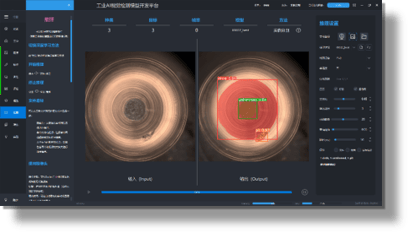
The Hongbai E-Series AI Vision Electrode Cap Dressing Inspection Systemcombines a high-resolution industrial camera with advanced AI deep-learning algorithms to automatically inspect electrode caps immediately after dressing.
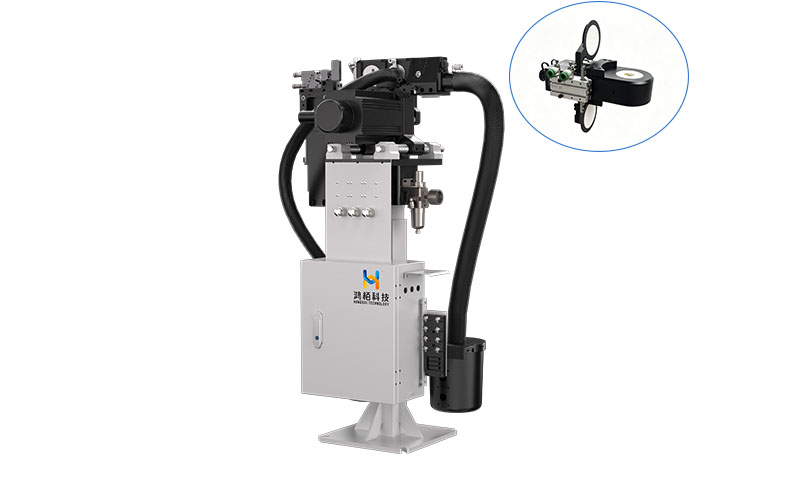
The system can accurately identify common dressing defects, including:
• Burn marks
• Copper pickup
• Surface pits
• Raised surfaces
• Star-shaped wear patterns
• Radial cracks
• Oversized or undersized electrode face
• Off-center electrode face
• Out-of-round electrode face
• Incomplete dressing
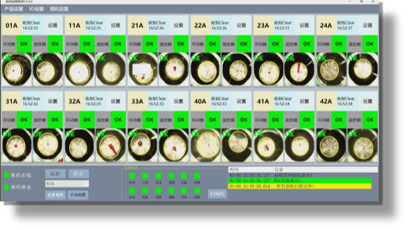
After the robot completes the dressing process, the system automatically captures an image and completes the inspection within seconds.
Qualified electrode caps proceed directly to the next welding cycle.
If a defect is detected, the system immediately generates an alarm and can communicate with the PLC to stop production or initiate corrective actions, preventing defective electrodes from entering the welding process.
This enables a true “Inspect Before Welding” quality control strategy.
Value Delivered by AI Vision Inspection
Compared with conventional inspection methods, the greatest advantage of AI vision is not simply better visibility—it transforms electrode dressing into a standardized, data-driven quality management process.
Standardized Dressing Quality
Every electrode cap is evaluated using the same inspection criteria, eliminating operator-to-operator variation.
Improved Weld Consistency
Abnormal electrode conditions are detected before welding begins, significantly reducing weak welds, expulsion, and insufficient weld nugget formation.
Predictive Maintenance
Historical inspection data enables trend analysis, helping optimize dressing intervals and electrode replacement schedules.
Full Quality Traceability
Every inspection result is automatically recorded, providing reliable data for process analysis and quality assurance.
From Experience-Based Maintenance to Data-Driven Manufacturing
AI vision inspection is more than an inspection tool—it is a key component of intelligent resistance spot welding quality management.
By integrating with robots, PLCs, and Manufacturing Execution Systems (MES), the system establishes a closed-loop quality control process:
Inspection → Decision → Alarm → Correction → Data Analysis → Process Optimization
Every dressing cycle is verified by objective data, and every weld becomes fully traceable.
Conclusion
Consistent spot weld quality depends not only on the welding controller or welding process parameters, but also on maintaining every electrode cap in optimal condition.
The Hongbai E-Series AI Vision Electrode Cap Dressing Inspection System transforms traditional experience-based electrode maintenance into a measurable, traceable, and intelligent quality management process.
Designed for high-volume automotive manufacturing and other automated resistance spot welding applications, it improves weld consistency while providing a solid foundation for predictive maintenance and smart manufacturing.
As welding automation continues to advance, competitive advantage will increasingly depend not only on equipment performance, but also on data-driven quality control that ensures every weld meets the highest standard.