
In July 2026, at the AMTS Shanghai International Automotive Manufacturing Technology & Material Show, Hongbai Technology made the global debut of its fully self-developed AI foundation-model-powered 螺柱焊接 quality inspection system. It is also the world’s first quality management system integrating an AI foundation model specifically for stud welding applications.
As AI foundation models rapidly transform industries worldwide, Hongbai Technology is bringing this transformation to the welding industry. After six generations of welding technology evolution, the company has consistently focused on the integration of data, algorithms, and real-world industrial scenarios, while addressing four fundamental challenges in industrial AI.
Through the dual revolution of “Welding + AI,” Hongbai Technology is pioneering a new paradigm for stud welding quality management—moving from experience-driven quality control to data- and algorithm-driven intelligence.
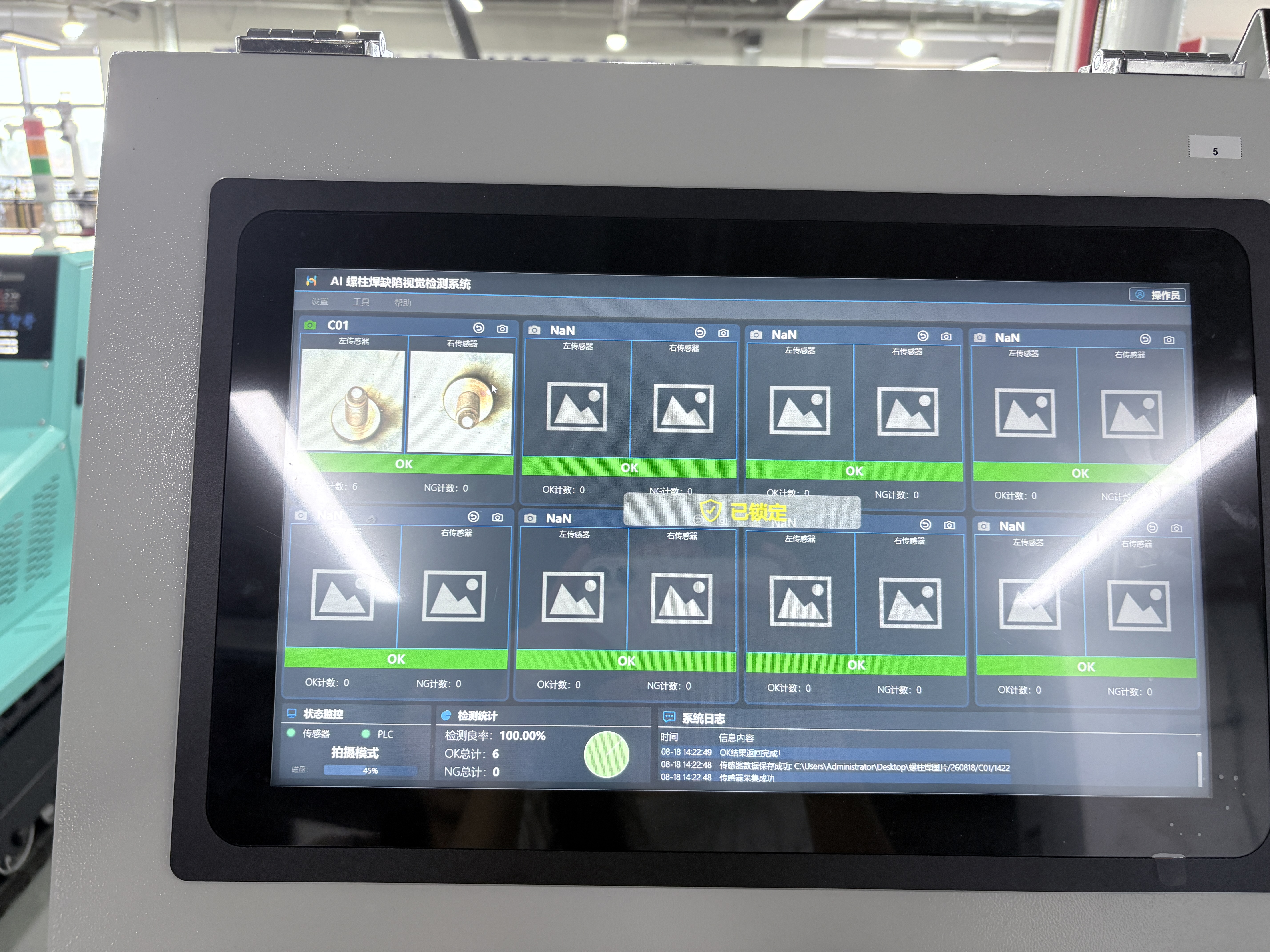
1. Industry Challenges: Four Limitations of Traditional Quality Inspection
1.1 Fragmented and Heterogeneous Data
In high-volume stud welding production, traditional quality management faces a series of systemic challenges.
Fragmented and heterogeneous data: Quality records are often scattered across paper documents, PowerPoint files, Excel spreadsheets, welding equipment, and other systems, making data integration time-consuming and inefficient.
1.2 Slow Problem Detection and Response
Quality issues may take up to four hours to be detected under periodic inspection. Once identified, the escalation and feedback process may require another 1–2 hours, while problem resolution can take up to 3.5 hours.
In addition, compiling daily quality inspection reports can consume approximately 2.25 hours of labor every day.
For high-volume automotive production, such delays increase the risk of quality issues escaping downstream and can lead to additional rework and production costs.
1.3 Manufacturing Knowledge Is Difficult to Capture and Reuse
Root cause identification and corrective action often depend heavily on the experience of individual engineers and technicians.
When critical welding knowledge remains primarily within individual experts, it becomes difficult to standardize, transfer, and reuse across production lines and teams.
1.4 Quality Control Struggles to Keep Pace with Production Capacity
Traditional inspection and problem-solving processes may struggle to keep pace with high-volume production requirements of up to 60 JPH.
Delayed defect detection and response can result in increased rework, higher quality costs, and reduced production efficiency.
2. System Overview: Integrating Data, Algorithms, and Industrial Scenarios
Hongbai’s system integrates two complementary technology paths: welding process big data and AI-powered machine vision inspection.
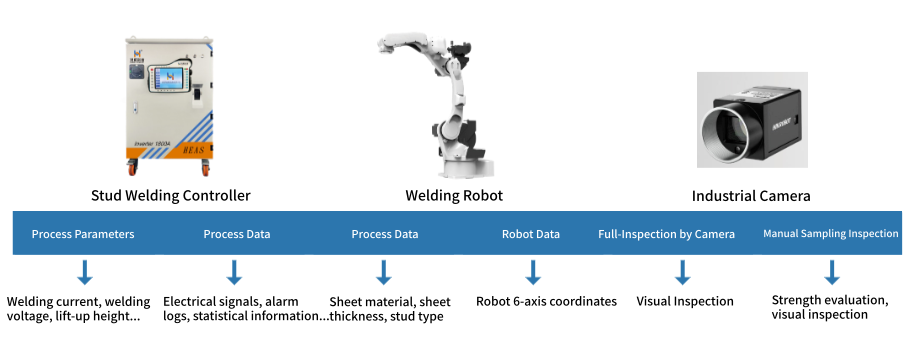
The system is built around three core hardware components: stud welding controllers, welding robots, and industrial cameras, enabling comprehensive data acquisition across six major dimensions.
Six Dimensions of Welding Data
Process Parameters: Welding current, welding voltage, lift height, and other critical welding parameters.
Process Data: Electrical signals, alarm logs, and equipment status information.
Material Information: Sheet material, sheet thickness, stud type, and related material characteristics.
Robot Data: Six-axis coordinates and robot positioning information.
Machine Vision Inspection: 100% visual inspection of welded studs and weld appearance.
Manual Sampling Inspection: Weld strength evaluation and appearance inspection.
Underlying Technology Architecture
The underlying architecture consists of a real-time welding process data acquisition gateway, a ClickHouse-based welding big data platform, AI models for welding OK/NG and defect-type prediction, welding anomaly root cause analysis, multi-dimensional KPI correlation analysis, and welding process management software.
The WeldNIC group control system enables unified data acquisition and centralized management of multiple welding devices, while providing real-time monitoring of critical parameters such as arc voltage, welding current, motor position, and welding force.
The system also integrates multiple data sources, including sheet material information, welding takt time, welding gun data, and production data, enabling comprehensive digital management of welding quality and production processes.
3. Full-Cycle Intelligent Management: From Problem Detection to Knowledge Accumulation
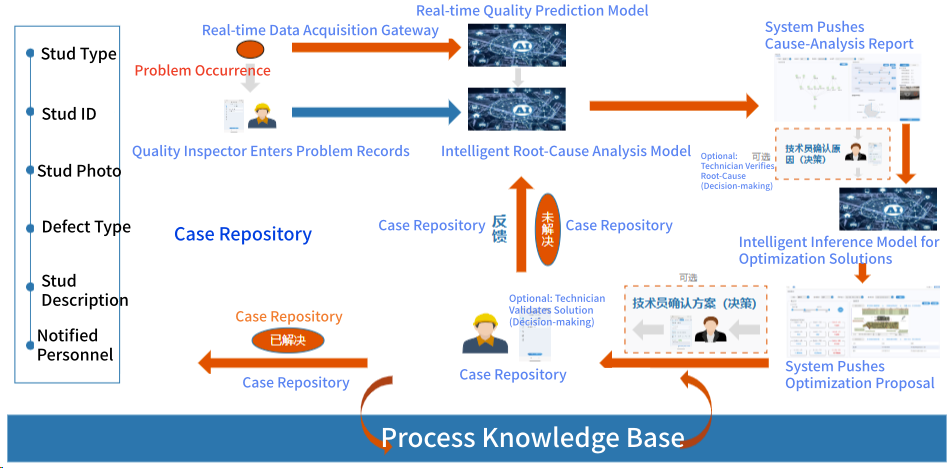
The system establishes a complete digital closed loop covering detection, feedback, diagnosis, action, and resolution.
When a quality issue occurs, real-time process data is transmitted through the data acquisition gateway to the real-time quality prediction model. At the same time, quality inspectors can record the issue directly in the system, with the information automatically fed into the AI root cause analysis model.
The system automatically generates and delivers a root cause analysis report. After the technician confirms the cause, the intelligent optimization model recommends appropriate corrective actions and process improvement solutions.
Operators then implement the corrective actions and provide feedback. Resolved cases are automatically converted into reusable knowledge assets containing information such as stud type, stud ID, stud image, defect type, defect description, and notified personnel.
Unresolved issues are returned to the root cause analysis model for further evaluation and continuous iteration, helping reduce problem-solving time from hours to minutes.
4. Dual Inspection with Vision + Electrical Data: Making Every Weld Traceable and Reliable
Hongbai’s system combines AI machine vision inspection with real-time electrical process monitoring, creating a dual-layer approach to stud welding quality inspection.
On the visual inspection side, a high-resolution industrial camera J1280-30GM captures clear images of each welded stud.
The camera features:
- Pixel size: 3.75 μm × 3.75 μm
- Resolution: 1280 × 960
- Image resolution: 1.23 megapixels
- Frame rate: 30 fps
AI-powered image analysis then generates automated visual quality reports.
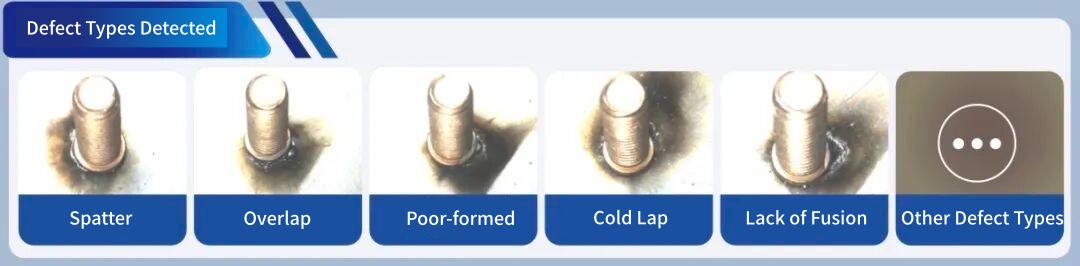
The system can identify potential appearance-related defects such as incomplete welds, weak welds, stud misalignment, and excessive weld material, while automatically archiving post-weld images for quality traceability.
At the same time, the system continuously monitors welding electrical signals and process parameters.
By combining visual evidence with real-time process data, the system provides two complementary layers of welding quality verification.
Industry applications have demonstrated that AI machine vision based on industrial cameras and deep learning algorithms such as YOLOv8 can identify defects including weld cracks longer than 2 mm, porosity larger than 1 mm in diameter, stud inclination greater than 2°, and thread damage involving more than one damaged thread.
In representative applications, online inspection speeds can reach up to 1,000 pieces per hour, while false-positive rates can be reduced from 5% to 0.1% after model optimization.
5. Experience + AI: Turning Welding Expertise into Digital Knowledge Assets
Hongbai’s system enhances industrial intelligence through four key pillars: accumulated manufacturing experience and data, an intelligent knowledge base, automated diagnosis and recommendations, and advanced AI agent technologies.
At the knowledge digitalization level, multi-modal factory knowledge can be structured into knowledge graphs for accumulation and reuse. Historical experience and engineering cases are also stored digitally, enabling online expert guidance and intelligent knowledge retrieval.
At the capability enhancement level, 24/7 online training and knowledge support help production personnel develop fundamental stud welding troubleshooting capabilities, while enabling specialized technicians to focus on more advanced and complex engineering challenges.
6. AI Quality Inspection vs. Traditional Inspection: From Sampling to 100% Inspection
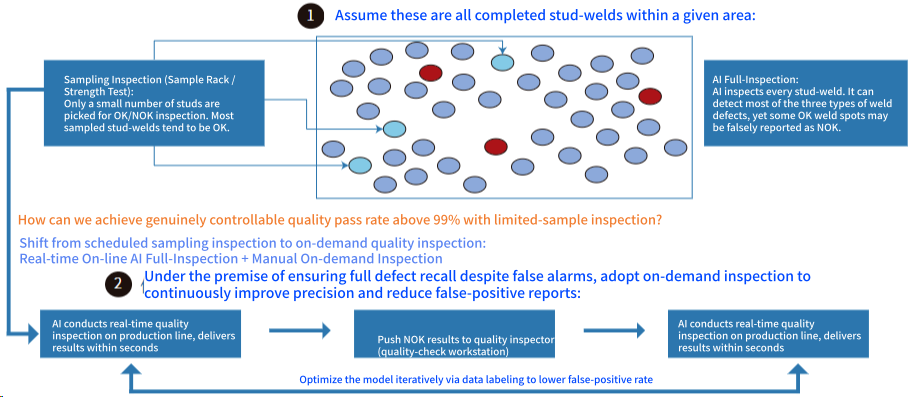
Traditional inspection methods, such as sample-based fixture testing and destructive strength testing, typically inspect only a limited number of studs for OK/NG verification.
Although most sampled studs may meet quality requirements, sampling alone cannot provide continuous visibility into the quality of every weld on a high-volume production line.
AI-powered quality inspection takes a fundamentally different approach by enabling 100% inspection of welded studs, significantly increasing the probability of identifying defective welds before they move downstream.
The system transforms quality inspection from scheduled sampling inspection to demand-driven quality inspection.
AI performs real-time inspection directly on the production line and delivers results within seconds. Suspected NG welds are automatically flagged and sent to the quality inspection station for targeted verification.
Through continuous labeling and model optimization, false positives can be progressively reduced, creating a self-improving quality management loop.
7. Core Value: Four AI-Powered Quality Management Modules
| English Value Module | Core Capability | Quantified Benefit | |
|---|---|---|---|
| Real-Time Quality Prediction | Real-time parameter monitoring, defect feedback within minutes, transition from sampling to 100% inspection | First-pass yield improved by up to 70%; rework rate reduced by up to 80% | |
| AI Root Cause Analysis | Intelligent cause recommendation, root cause chain analysis, automated information delivery | Problem-solving time reduced from hours to minutes | |
| Intelligent Recommendations | From decision support toward autonomous decision-making | Process optimization efficiency improved by up to 90% | |
| AI-Powered Expert Guidance | Online training, intelligent process knowledge retrieval, expert knowledge accumulation | Shared and reusable engineering knowledge |
8. Product Portfolio: Scalable Solutions for Different Production Lines
Basic Edition
The Basic Edition provides an entry point for manufacturers adopting AI-powered welding quality management.
Key functions include:
- AI welding quality prediction
- Real-time welding quality analysis
- Fault-code-level feedback
- Optional machine vision inspection
Standard Edition
The Standard Edition adds advanced defect prediction and intelligent production management capabilities.
Key functions include:
- Defect type prediction
- Intelligent stud welding management system
- Real-time visual alarms
- Online tracking and positioning
- Historical data traceability
- Host computer data acquisition software
- Intelligent edge computing box with Intel Core i5-10500E
Flagship Edition
The Flagship Edition is designed for advanced smart manufacturing environments.
In addition to the Standard Edition capabilities, it includes:
- Stud welding process mechanism knowledge graph
- Industrial big data processing environment
- Advanced AI analysis capabilities
- Integrated edge computing cabinet
This tiered architecture allows manufacturers to progressively upgrade from AI quality prediction to comprehensive intelligent stud welding quality management.
9. From Fifth-Generation Welding Technology to AI-Powered Quality Management
From the evolution of its fifth-generation welding technology to the development of what Hongbai Technology presents as the world’s first stud welding quality management system integrating an AI foundation model, Hongbai has remained committed to its mission of advancing China’s automotive equipment manufacturing industry.
The introduction of the AI Quality Analysis System marks a new stage in stud welding quality management—defined by four core capabilities:
Real-Time Prediction → Intelligent Root Cause Analysis → Intelligent Recommendations → Knowledge Accumulation
AI-Enabled Welding. Intelligent Manufacturing. A Smarter Future.
关于宏柏科技
Founded in 2003, Shenzhen Hongbai Technology Industrial Co., Ltd. specializes in intelligent welding equipment, stud welding systems, automotive welding solutions, industrial automation, and digital welding technologies.
With decades of experience in welding technology development and automotive manufacturing applications, Hongbai Technology continues to integrate welding expertise, industrial data, automation, and artificial intelligence to deliver smarter welding solutions for manufacturers worldwide.
Should you have any inquiries, please feel free to reach out to us.
👉Email: jiangna@sawchina.com