
1. Start with the Application: How to Choose the Right Stud Welding Machine?
As automotive manufacturing, sheet metal fabrication, appliance production, machinery manufacturing, and industrial automation continue to evolve, stud welding is moving from traditional manual operations toward automated, robotic, and digital production. For manufacturers, selecting a 螺柱焊机 is no longer simply about comparing maximum welding current. Stud diameter, workpiece material, sheet thickness, required joint strength, production cycle time, and automation level all influence the final equipment selection.
As a company specializing in intelligent welding equipment and industrial automation, Hongbai Technology has been developing stud welding technology since 2003. Its product portfolio covers capacitor discharge stud welding, short-cycle drawn arc welding, AC/DC stud welding, CNC automatic stud welding platforms, and robotic stud welding systems. Depending on the material, stud specification, and production method, Hongbai can provide complete solutions covering welding power sources, servo welding guns, automatic stud feeders, robots, and CNC platforms.
Before selecting a machine, therefore, the first question should be: What type of stud welding process does your application actually require?
2. Choose the Welding Process Before Choosing the Machine
Different stud welding processes operate differently and therefore have different requirements for the welding power source and welding gun. The two main processes used in industrial production are capacitor discharge stud welding and drawn arc stud welding.
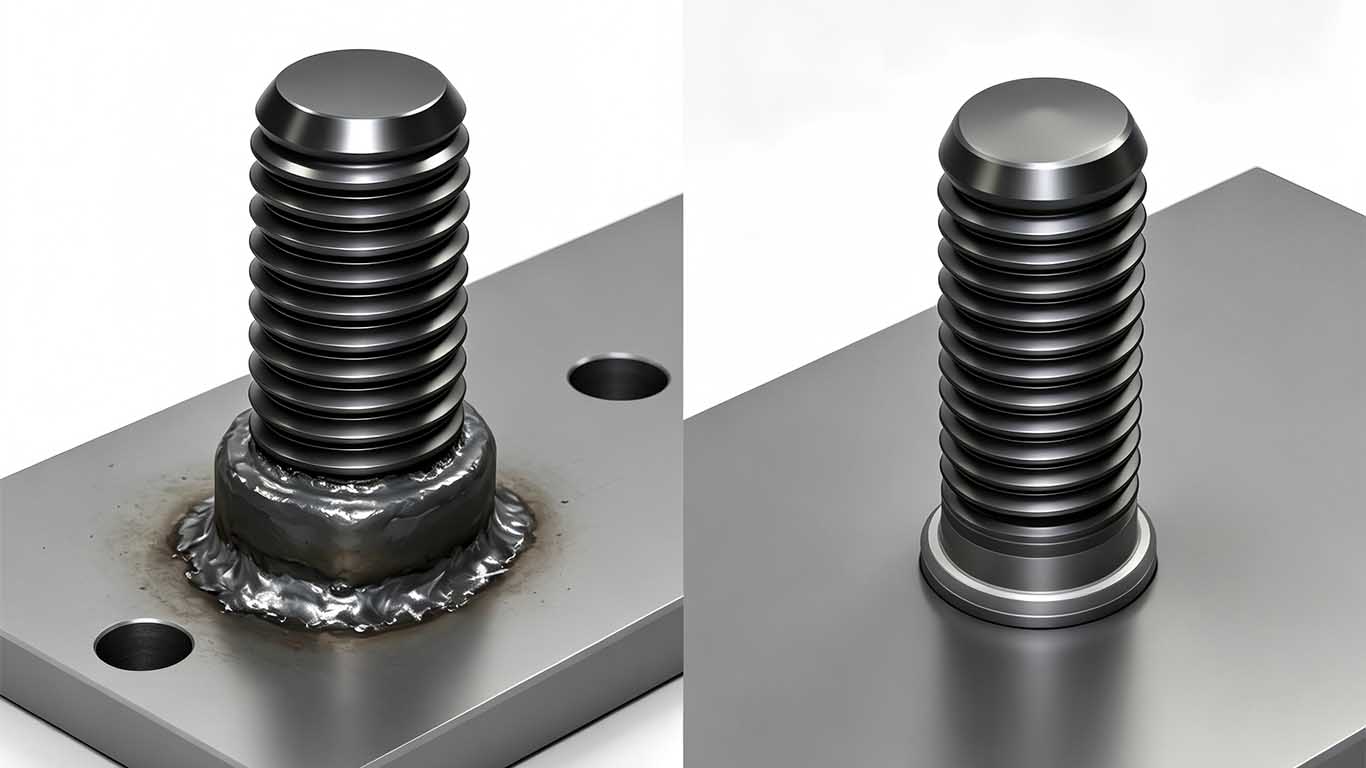
Capacitor discharge stud welding uses stored capacitor energy to complete the weld within an extremely short period, typically around 1–3 ms. This results in low heat input and minimal thermal impact on thin sheets. It is particularly suitable for small-diameter studs, typically 3–8 mm, thin sheet applications, and components where backside deformation must be minimized.
Drawn arc stud welding, on the other hand, uses the welding gun to lift the stud and create an arc between the stud and workpiece. The arc melts both surfaces before the stud is plunged into the molten pool. Because it produces greater melt volume and penetration, drawn arc welding generally provides higher joint strength and greater process flexibility.
Short-cycle drawn arc welding is particularly common in automotive body manufacturing, galvanized steel applications, and robotic welding. For larger studs and high-strength structural components, long-cycle drawn arc welding may be more appropriate.
In other words, there is no single stud welding machine that is ideal for every application. Proper machine selection starts with choosing the right welding process.
3. Welding Current and Stud Diameter: How Much Power Do You Need?
Once the welding process has been determined, the next step is to determine the required output capability of the welding machine. Among the key factors, stud diameter is one of the most important indicators for determining welding current requirements.
For short-cycle drawn arc stud welding, the following empirical formula can be used as an initial reference:
Welding current ≈ Stud diameter × 100 A
For example, a 6 mm stud can initially be tested at approximately 600 A. Welding time can also be estimated using:
Welding time ≈ Stud diameter × 4 ms
This gives an initial welding time of approximately 24 ms for a 6 mm stud.
However, these formulas should be regarded as starting points for process development rather than fixed standards. Actual parameters must be optimized according to stud material, workpiece material, sheet thickness, surface coating, and welding gun characteristics.
This is why equipment selection should not be based solely on maximum current. A machine capable of producing 2000 A does not mean every application requires 2000 A. More importantly, the power source must provide fast, stable, and repeatable current control throughout the actual process window.
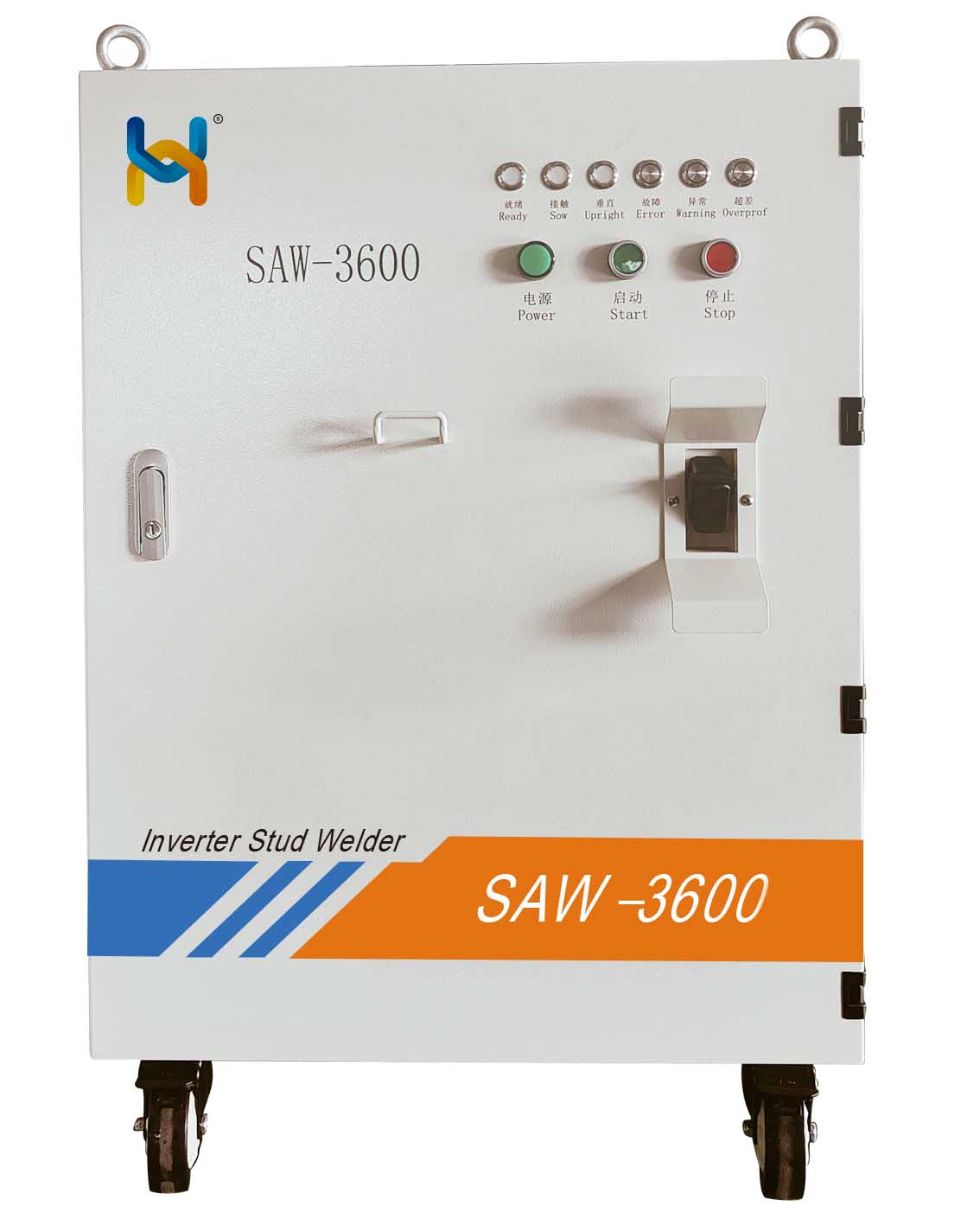
Hongbai Technology’s SAW-3600 series provides up to 1800–2000 A of output current and supports 3–12 mm studs for short-cycle drawn arc welding, providing a broad process range for automotive body panels, sheet metal, and industrial automation.4. Material and Sheet Thickness Determine the Process Window
4. Material and Sheet Thickness Determine the Process Window
In addition to stud diameter, the materials of both the stud and workpiece also determine the appropriate welding parameters.
Conventional carbon steel and stainless steel generally offer good compatibility with stud welding. For galvanized steel, short-cycle drawn arc welding provides a particular advantage because the pilot arc can help clean the coating in the welding area and reduce the influence of zinc on arc initiation and fusion.
For highly conductive and thermally conductive materials such as aluminum and copper, energy control becomes more sensitive. The welding system needs not only sufficient output current but also good dynamic response and precise parameter control.
Sheet thickness is another important factor. Extremely thin sheets may be susceptible to burn-through or backside marking, while thicker sheets may require greater welding energy and penetration.
Therefore, before determining machine capacity, manufacturers should evaluate stud diameter + sheet thickness + material + required joint strength together.
For applications with significant variation in materials and welding conditions, digitally controlled welding systems generally provide greater flexibility for establishing a stable process window.
5. Why Is Precision Becoming More Important in Automated Stud Welding?
As stud welding moves from manual operation to CNC and robotic automation, the criteria for evaluating equipment also change.
During manual welding, operators can continuously adjust the welding gun position according to the workpiece. In automated production, however, the robot or CNC platform must execute hundreds or even thousands of weld points according to programmed coordinates. Therefore, weld position accuracy and repeatability directly affect downstream assembly quality.
The final positioning accuracy of an automated stud welding system is not determined solely by the robot’s repeatability.
It is the combined result of several factors:
Robot positioning → welding gun positioning → stud feeding → stud stick-out → fixture positioning → welding gun lift motion → final weld position
Any error in one of these stages can ultimately appear as weld position deviation.
Therefore, when selecting an automated stud welding system, manufacturers should evaluate not only robot repeatability but also welding gun motion control, stud feeding stability, and fixture accuracy.
6. For High-Precision Automated Stud Welding, the Welding Gun Is Critical
In an automated stud welding system, the welding gun is more than a simple mechanism for holding the stud and performing the weld. Its lift height, motion speed, plunge action, and position feedback can all influence arc length and final weld quality.
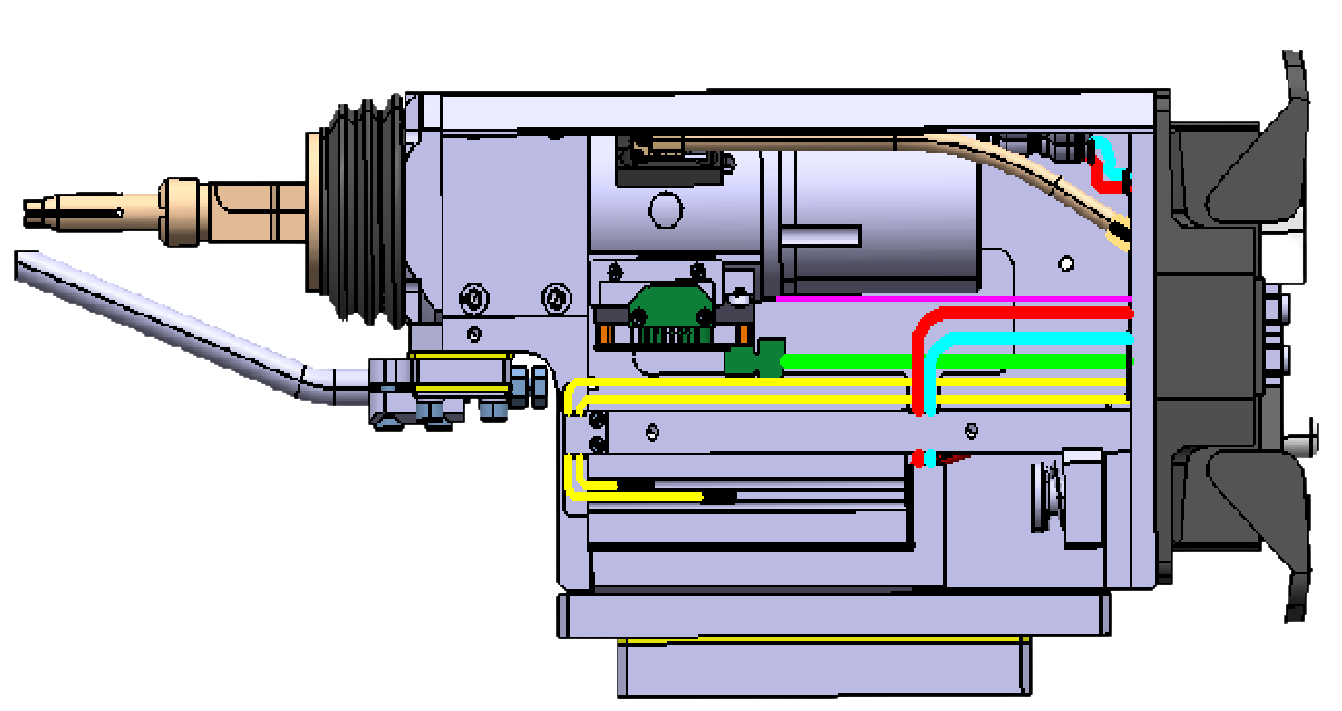
Traditional mechanical or pneumatic welding guns can be affected by air-pressure fluctuations, mechanical clearance, and long-term wear. In comparison, servo welding guns use motor-driven motion to achieve more precise control of the lifting movement.
Hongbai Technology’s PIDS series uses linear servo drive technology combined with grating feedback to monitor welding gun lift position, creating a more stable closed-loop motion control system.
For automotive body panels, high-strength steel, aluminum alloys, and robotic welding applications where consistency is critical, this approach can improve repeatability between individual weld points.
Therefore, if the goal is not simply to “automate welding” but to achieve high-precision, stable, and traceable automated stud welding, welding gun motion control should be a key consideration.
7. From Automated Welding to High-Precision Automated Welding
A truly automated stud welding system must control more than the welding action itself. It must ensure consistency throughout the entire production process.
First, the feeding system must deliver every stud reliably and continuously to the welding gun. The robot or CNC platform must then reach the programmed position accurately. The servo welding gun performs controlled lifting and plunge movement, while the welding power source delivers the required energy rapidly and consistently.
When process data such as current, voltage, welding time, and energy are also recorded, traditional “final inspection” can gradually evolve into real-time process monitoring.
This is one of the key differences between modern intelligent stud welding systems and conventional stud welding equipment.
Hongbai Technology integrates welding power sources + servo welding guns + automatic stud feeders + CNC/robotic platforms + digital control systems to provide complete automated stud welding solutions covering feeding, positioning, welding, and process data management.
8. How to Choose the Right Stud Welding Machine for Your Application
If your application mainly involves thin sheets, small-diameter studs, and strict requirements for minimizing backside marks, capacitor discharge stud welding can be a good choice. Hongbai Technology’s SAW-DVI and PFC series are suitable for 3–8 mm studs and thin-sheet applications.
For automotive body panels, galvanized steel, 3–12 mm studs, and higher production requirements, short-cycle drawn arc welding is generally more suitable. Hongbai Technology’s SAW-3600 series provides up to 1800–2000 A of output current and can be configured with different numbers of welding channels according to production requirements.
For applications involving high-strength steel, aluminum alloys, or robotic automation, the PIDS series can provide a more advanced solution. Its AC/DC output, digital control, and servo welding gun technology are designed for more demanding automated welding applications.
When production requirements expand to automatic feeding, robotic positioning, high-volume welding, and quality data management, the welding machine should be selected as part of a complete system rather than as an isolated power source.
9. Don’t Choose a Stud Welding Machine Based Only on Maximum Current
A simple logic can be used when selecting a stud welding machine:
Start with stud diameter, then consider material and sheet thickness;
determine the welding process, then establish the required current and time;
finally, select manual, CNC, or robotic automation according to production requirements.
For thin-sheet applications with 3–8 mm studs, capacitor discharge systems can be considered. For 3–12 mm studs used on automotive body panels and galvanized steel, short-cycle drawn arc welding is often the preferred option. For large-diameter studs and high-strength structural components, a higher-power drawn arc system may be required.
For automated production, manufacturers should also evaluate welding gun positioning accuracy, lift-height control, stud feeding stability, robot repeatability, fixture accuracy, and welding data monitoring rather than focusing only on welding current.
Ultimately, the best stud welding machine is not necessarily the machine with the highest specifications. It is the system that is best matched to the product, material, welding process, and production cycle.
10. Hongbai Technology: From Stud Welding Machines to Intelligent Automated Welding Systems
For production requirements ranging from basic manual welding to highly automated manufacturing, Hongbai Technology offers a complete product portfolio covering capacitor discharge stud welding, short-cycle drawn arc welding, AC/DC stud welding, CNC automatic stud welding, and robotic stud welding.
From compact capacitor discharge machines for thin-sheet applications to the SAW-3600 series for automotive manufacturing and advanced PIDS systems for high-end automation, Hongbai Technology can configure complete solutions according to stud diameter, material, sheet thickness, production cycle time, and automation requirements.
For customers seeking higher positioning accuracy and production consistency, servo welding guns, automatic stud feeders, CNC platforms, and robotic systems can be integrated to upgrade traditional manual welding into automatic positioning, automatic feeding, automated welding, and digital quality management.
Ultimately, selecting a stud welding machine is not simply about purchasing a piece of equipment. It is about choosing a manufacturing solution capable of delivering stable operation, higher productivity, and consistent welding quality over the long term.