


Why Monitor Penetration in Stud Welding?
In stud welding, the result is not simply about whether the stud is attached to the workpiece.
When the stud tip and workpiece surface are melted, sufficient fusion must be achieved to form a reliable joint. Insufficient fusion can affect joint strength, while excessive heat input may cause localized overheating or even burn-through when welding thin sheet metal.
In conventional production, engineers typically control the process through parameters such as welding current, welding time, and lift height, followed by visual inspection and sampling-based destructive testing.
But these methods do not always answer a more direct question:
What actually happened to this individual stud during the weld?
This is where the penetration monitoring function of the PIDS Series Stud Welding System comes into play.
The system monitors the change in stud position before and after welding, calculates the corresponding penetration value, and provides the result on the operator interface after the weld is completed.
Penetration therefore becomes a measurable process variable rather than something that can only be evaluated indirectly through post-weld inspection.
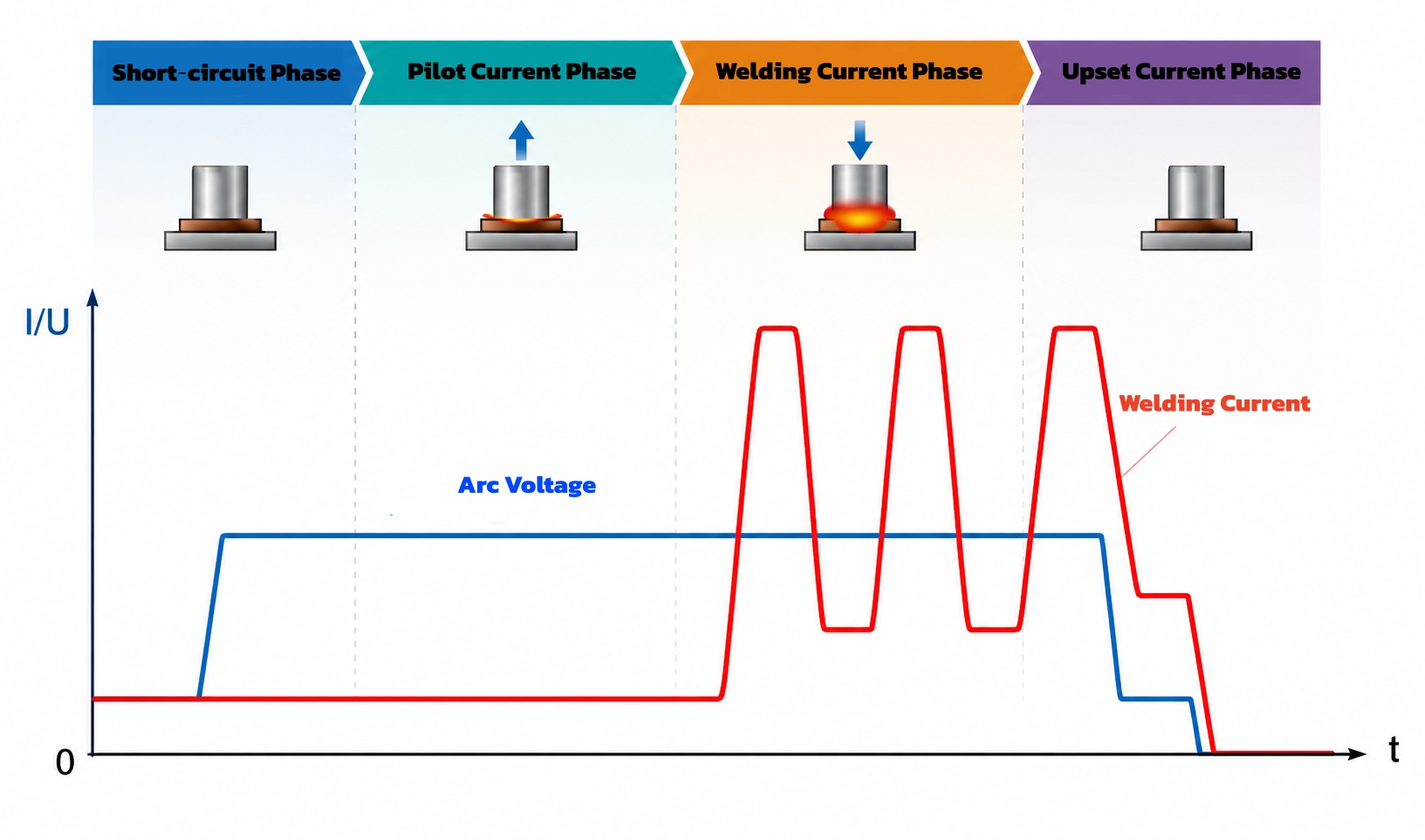
1. How Does PIDS Penetration Monitoring Work?
1.1 The Principle Is Measurement, Not Visual Inspection
PIDS penetration monitoring does not rely on a camera to directly observe the molten pool after welding. Instead, it is based on the change in stud position before and after the welding cycle.
Before welding begins, the system establishes the initial stud position as a reference.
Once the arc is initiated, the stud tip and workpiece surface melt to form a molten pool. The stud then moves into the molten pool and the weld is completed. After welding, the system records the final stud position.
The change between the initial and final positions is then used to calculate the corresponding penetration value.
The process can be simplified as:
Initial Position → Arc Initiation and Melting → Stud Movement into the Molten Pool → Final Position → Position Change → Penetration Calculation
The PIDS system uses servo-driven feeding and position feedback in the FRS Series feeding system. The welding gun uses a linear-motor-driven lifting mechanism with position sensing, providing the motion data required for stud positioning and penetration calculation.
2. How Is the Penetration Value Generated?
Step 1: Record the Initial Position
Once the welding gun reaches the weld position, the system records the initial position of the stud.
This position serves as the reference for the subsequent calculation.
Step 2: Perform the Welding Cycle
After arc initiation, the stud tip and workpiece surface melt to form a molten pool.
During the welding cycle, the stud follows the programmed motion and enters the molten pool to complete the weld.
Step 3: Record the Final Position
After the welding cycle is completed, the system records the final stud position.
Because the stud has moved into the molten pool, its position has changed relative to the initial reference point.
Step 4: Calculate the Penetration Value
The system calculates the corresponding penetration value from the position data recorded before and after welding.
In simplified terms:
Penetration ≈ Change in Stud Position Before and After Welding
The actual calculation also depends on the mechanical structure, position reference, and control logic of the system. Therefore, the measured position change should not simply be treated as a direct measurement of metallurgical penetration under every condition.
Step 5: Transfer and Display the Data
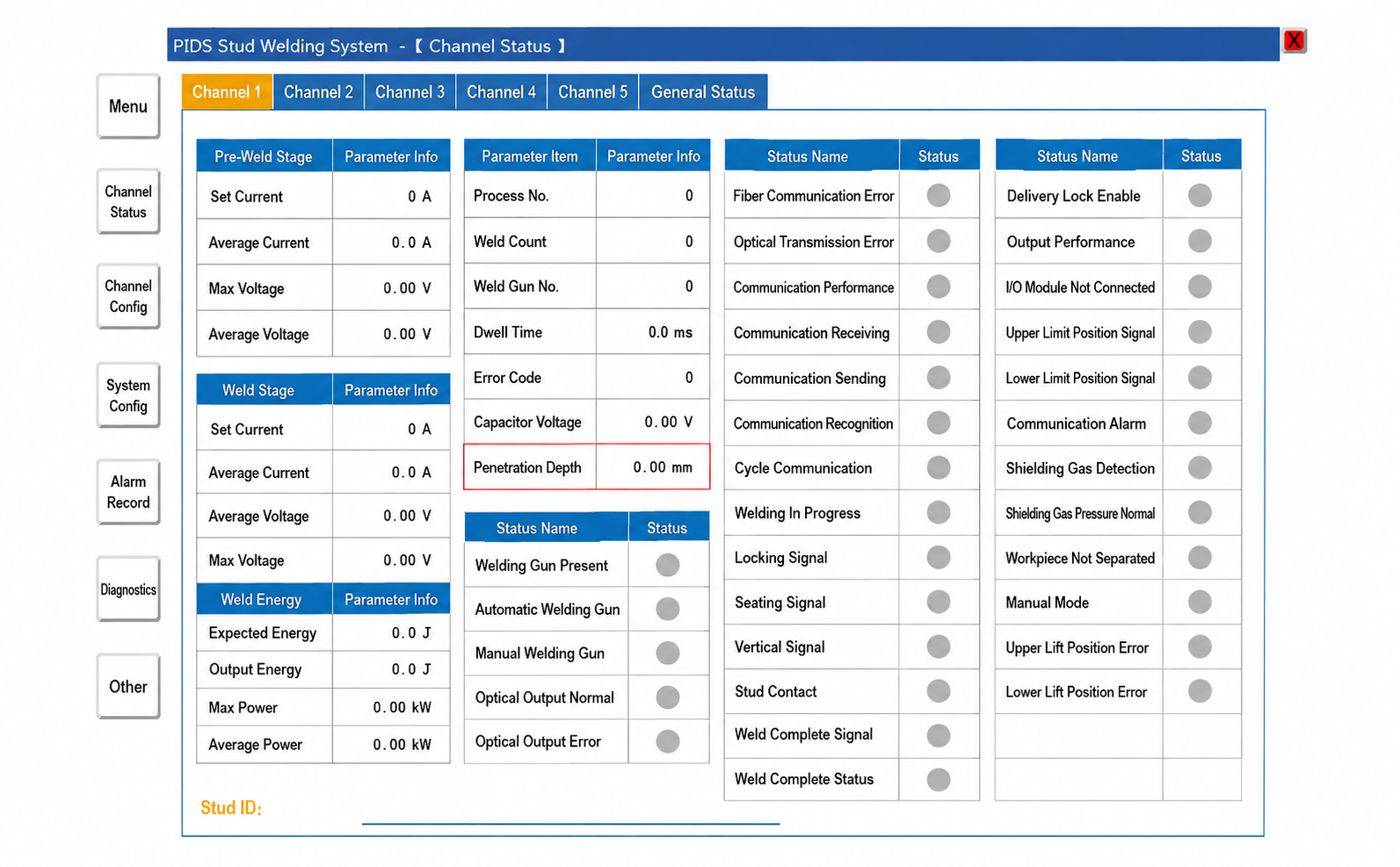
Once the calculation is completed, the penetration data is transmitted to the PIDS controller through the system communication link and displayed on the channel status interface of the handheld operator panel.
The operator can therefore review the penetration value immediately after each weld.
3. Why Is Position Feedback Important?
Penetration monitoring may appear to be a software function, but its foundation is the accuracy and stability of the mechanical motion and position-feedback system.
If the stud position cannot be measured consistently and accurately, the subsequent penetration calculation cannot provide reliable process information.
PIDS integrates the welding power source, stud feeding system, welding gun motion control, and position feedback into a single system.
The roles can be understood as follows:
- The feeding system delivers and positions the stud.
- The welding gun controls stud movement.
- The position-feedback system records the motion.
- The welding power source controls and acquires welding electrical parameters.
- The control system correlates the different data sets.
For this reason, penetration monitoring is not simply a matter of adding a separate “penetration sensor.”
It is based on the coordinated operation of the welding power source, feeding system, motion control, position feedback, and data processing system.
4. What Other Welding Data Can Be Evaluated Alongside Penetration?
After each weld, the PIDS handheld operator panel can display penetration together with other welding-process data.
| Parameter | Description |
|---|---|
| Penetration Depth | Calculated penetration value for the current weld |
| Set Current | Programmed welding current |
| Average Current | Average actual welding current during the weld cycle |
| Average Arc Voltage | Average arc voltage during welding |
| Maximum Arc Voltage | Maximum arc voltage recorded during the weld |
| Set Energy | Target energy defined by the welding process |
| Output Energy | Actual welding energy delivered |
| Average Power | Average welding power |
| Maximum Power | Maximum welding power |
| Process Number | Active welding process program |
| Weld Count | Accumulated weld count for the channel |
The value is not simply that one additional parameter is displayed.
What matters is that penetration can be evaluated together with welding current, arc voltage, energy, and other process data.
For example, when a change in penetration is detected, engineers can compare it with current and energy data to determine whether the change is more likely related to the welding process parameters or to other equipment and workpiece conditions.
5. What Happens When Penetration Is Out of Range?
For an automated production line, detecting an abnormal condition is only the first step.
The more important question is:
Can the system prevent the process from continuing once an abnormal weld is detected?
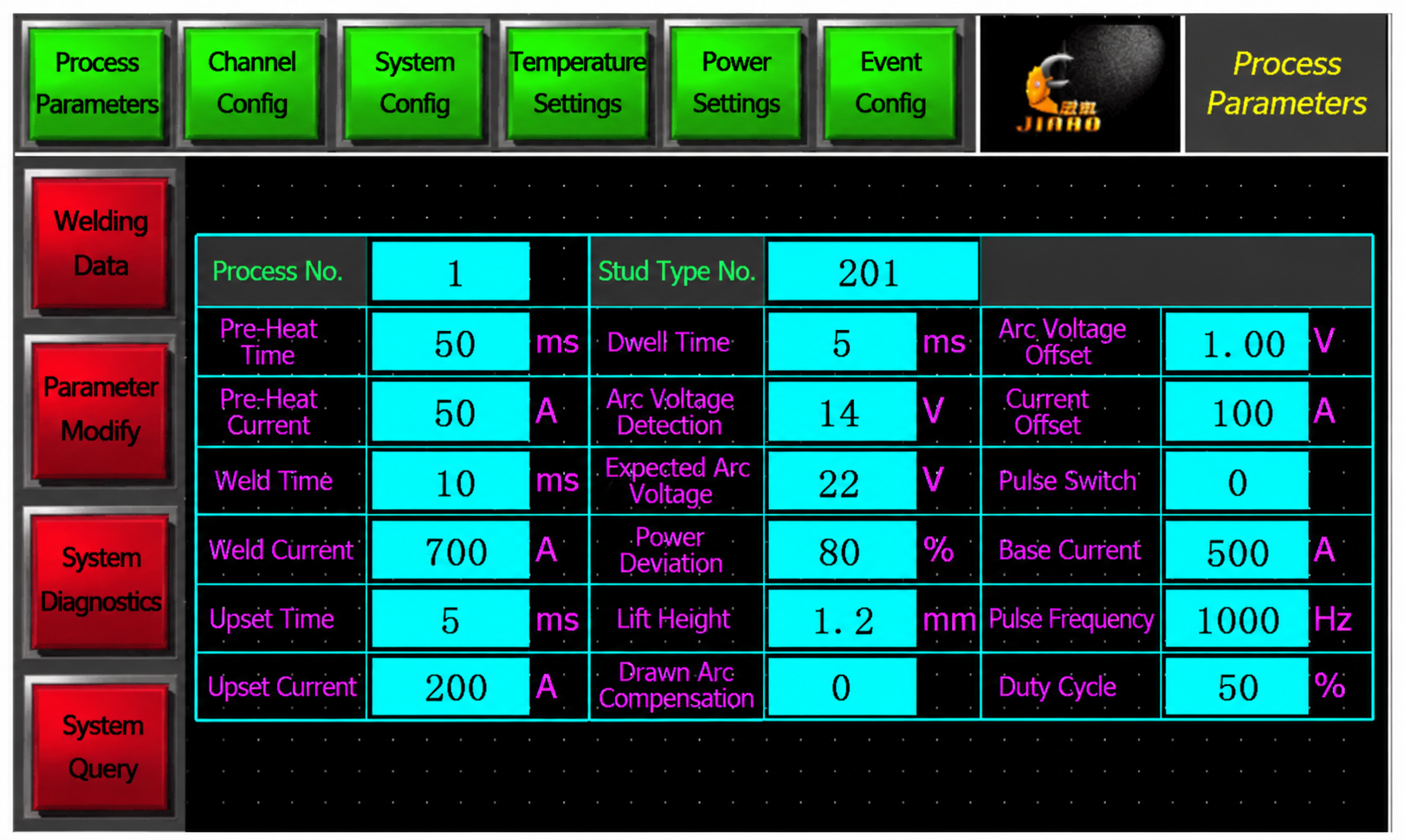
PIDS allows upper and lower penetration limits to be defined for individual welding processes.
If the measured penetration falls below the lower limit or exceeds the upper limit, the corresponding penetration alarm can be triggered.
The system provides:
- H-019: Penetration Below Lower Limit
- H-020: Penetration Above Upper Limit
When the main controller is configured as the penetration judgment source, an out-of-range value can trigger an alarm and interrupt the subsequent sequence according to the control logic of the automated production line.
This creates a process-control chain:
Welding → Data Acquisition → Penetration Calculation → Limit Check → Alarm → Process Interruption → Operator Verification
6. Penetration Limits Should Be Process-Validated
In production, how the upper and lower limits are defined can be just as important as having the alarm function itself.
If the monitoring window is too wide, abnormal welds may not be detected early enough. If it is too narrow, normal process variation may result in unnecessary alarms.
For this reason, penetration limits should be established based on the actual product and validated welding process.
A practical approach is:
Trial Welding → Data Collection → Variation Analysis → Mechanical Validation → Process Window Definition → Parameter Standardization
It is also important to recognize that:
A penetration value within the expected range should not be considered a complete substitute for weld-strength testing.
During new-product or new-process development, mechanical validation such as tensile or bend testing is still required to establish the relationship between the monitored penetration range and actual joint performance.
7. What Can Penetration Trends Reveal During Continuous Production?
A single penetration value provides information about an individual weld.
But when dozens, hundreds, or more welds are considered together, the data becomes much more useful.
Engineers can look for trends such as:
- A gradual decrease in penetration
- A gradual increase
- Periodic variation
- Sudden deviations
For example, if penetration remains stable at the beginning of production but gradually decreases over time, the welding gun, stud holder, feeding system, or workpiece surface condition may warrant further inspection.
One point is worth emphasizing:
Penetration monitoring is best used as an indication of process abnormality rather than as a stand-alone diagnostic tool.
It indicates that the welding result has changed. Engineers can then correlate that change with current, voltage, equipment condition, and other process information to identify the underlying cause.
8. Why Does Penetration Monitoring Matter in Multi-Channel Stud Welding?
When an automated stud welding line uses a single welding gun, troubleshooting an abnormal weld is relatively straightforward.
The situation becomes more complex when multiple welding guns and channels are involved.
When an abnormal welding result is detected, engineers need to determine:
Which channel? Which welding gun? Which process program? Which weld location?
PIDS supports multi-channel welding configurations, allowing penetration data to be associated with individual channels and process programs.
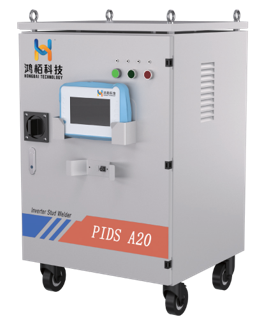
When a persistent penetration deviation occurs on a specific channel, engineers can therefore narrow down the potential source of the problem more efficiently instead of checking the entire production line.
9. Why Is Penetration Data Useful for Weld Traceability?
If penetration data remains only on the handheld operator panel, it mainly answers the question of whether the operator can see the result.
The value becomes greater when the data is incorporated into the production-management system.
Through USB, Ethernet, and other available interfaces, PIDS can support data export and MES integration according to project requirements.
For example, the following information can be associated:
Product Information + Weld Location + Process Number + Welding Current + Arc Voltage + Energy + Penetration + Alarm Records
When a quality issue occurs later, engineers can look beyond the finished product and trace the relevant welding-process data.
This is where traceability becomes meaningful.
It is not only about knowing “this stud had a problem.”
It is about being able to determine:
“Under what process conditions was it welded, what welding data was recorded, and did the penetration show any abnormal behavior?”
10. What Does PIDS Penetration Monitoring Actually Solve?
Ultimately, penetration monitoring is not about adding another “mm” value to the welding-machine interface.
It addresses a practical question that has always existed in stud welding:
The welding parameters can be set — but can the actual welding result be measured?
Traditionally, engineers have focused primarily on controlling how the weld is made.
With penetration monitoring, they can also examine what actually happened during the completed weld.
When penetration is evaluated together with current, arc voltage, energy, process number, alarm records, and other process data, a much more complete picture of the welding process can be built.
This becomes particularly relevant in automated production.
The higher the production rate and the greater the number of studs being welded, the more difficult it becomes to rely solely on manual sampling.
When every welding cycle can generate its own process data, the approach to quality control changes:
Instead of starting with a defective part and working backward, engineers can use process data to identify abnormal conditions earlier.
And that is perhaps the most practical value of penetration monitoring in the PIDS system.
If you are looking for a stud welding machine that truly enables data-driven weld penetration management and makes welding quality “visible,” the 鸿柏科技 PIDS Series is your ideal choice.
Follow Hongbai Technology on LinkedIn for more technical resources and industry insights.