


Aluminum welding is not just about increasing current
With the rapid development of electric vehicles (EVs) and lightweight automotive structures, aluminum has become increasingly important in Body-in-White (BIW) manufacturing.
However, welding aluminum is fundamentally different from welding steel.
Many manufacturers find that a conventional DC 螺柱焊接系统 can achieve stable results on steel studs but struggles when applied to aluminum components. Problems such as unstable arc behavior, porosity, insufficient fusion, and low pull strength often occur.
The reason is not simply insufficient welding current.
The real challenge comes from the unique physical properties of aluminum:
- High thermal conductivity
- Low melting temperature
- High melting point oxide layer
- Rapid heat dissipation
These characteristics determine that aluminum stud welding requires more precise control of heat input and current direction.
This is why advanced AC/DC stud welding technology has become an important solution for aluminum automotive applications.
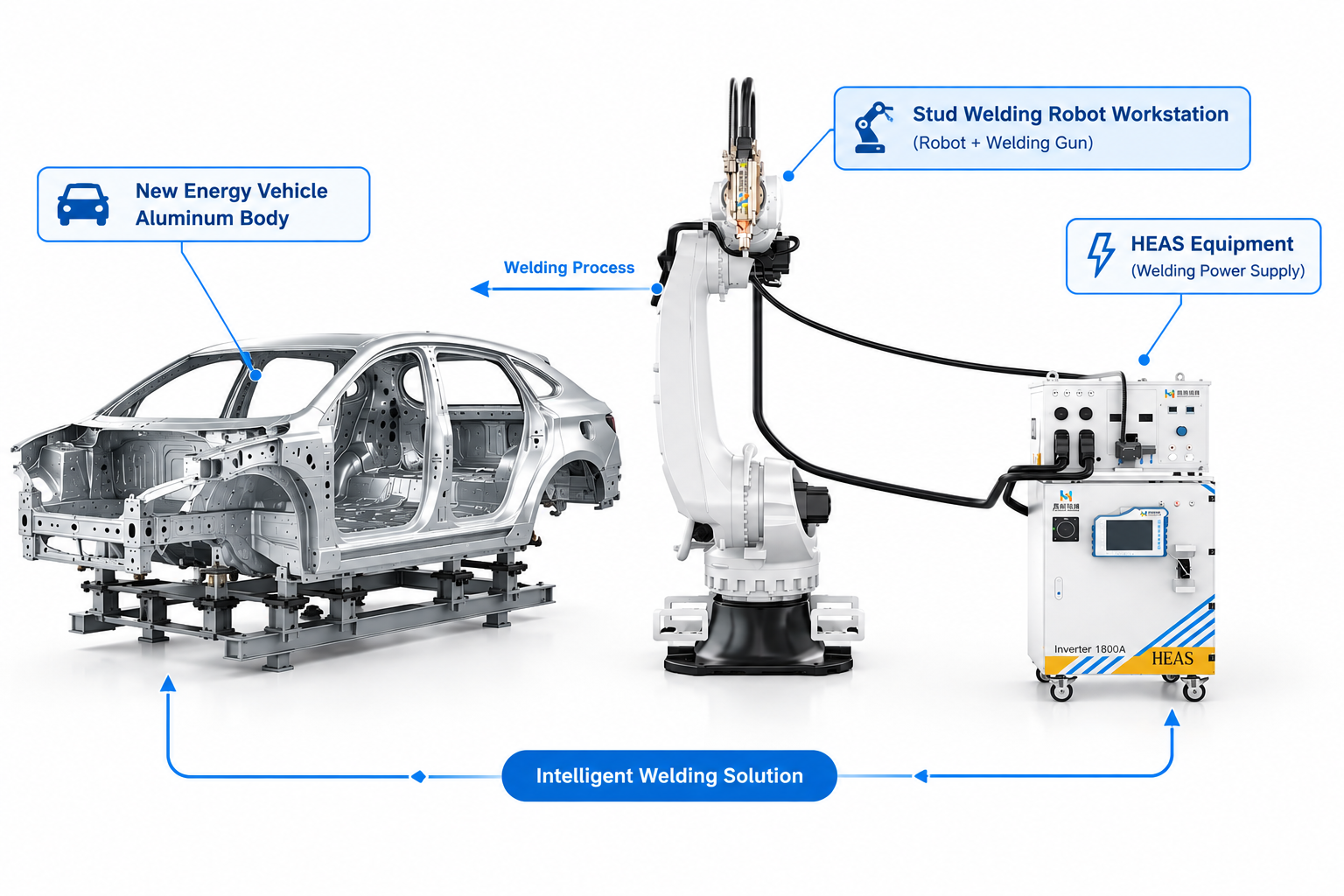
Aluminum vs Steel: Why the Welding Process Is Completely Different
Although aluminum and steel can both be joined through arc welding, their melting behavior is very different.
| Property | Steel | 铝 | Impact on Welding |
|---|---|---|---|
| Melting point | Approx. 1500℃ | Approx. 660℃ | Aluminum melts much earlier |
| Oxide layer | Thin oxide film | Al₂O₃ oxide layer, melting point approx. 2050℃ | Oxide layer is difficult to break |
| Thermal conductivity | Approx. 50 W/(m·K) | Approx. 237 W/(m·K) | Heat dissipates much faster |
| Density | 7.8 g/cm³ | 2.7 g/cm³ | Lightweight structure advantage |
| Molten pool stability | Relatively stable | Difficult to maintain | Requires precise heat control |
The biggest challenge is the aluminum oxide layer.
Although aluminum itself melts at around 660℃, the aluminum oxide layer on the surface requires temperatures above 2000℃ to break down.
This means:
Before the aluminum base material can melt properly, the oxide layer must first be effectively removed.
Without breaking this barrier, the stud and base material cannot form a strong metallurgical bond.
Why DC Stud Welding Has Limitations on Aluminum
Traditional DC stud welding systems are highly effective for steel applications.
However, when welding aluminum, fixed current direction creates several challenges.
1. Difficulty Breaking the Aluminum Oxide Layer
In DC welding, the current direction remains constant.
The arc heat distribution is therefore fixed, making it difficult to effectively disturb and remove the Al₂O₃ oxide layer.
The result may include:
- Incomplete fusion
- Weak weld strength
- Stud detachment during pull testing
2. Unbalanced Heat Distribution
The polarity of DC welding determines where most heat is generated.
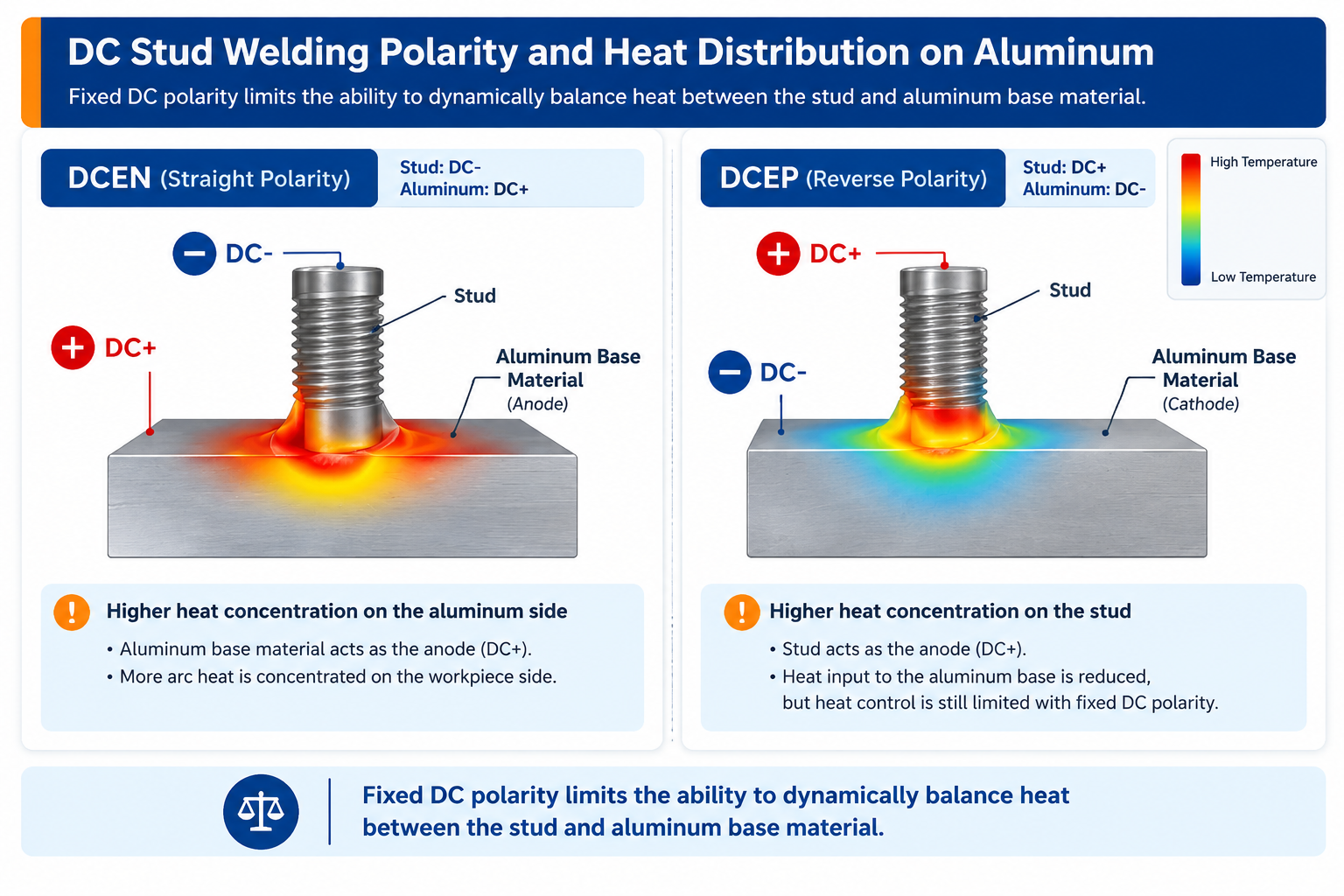
Depending on polarity:
- Too much heat on the base material may cause thin aluminum sheets to burn through.
- Too much heat on the stud side may result in insufficient penetration.
For aluminum automotive components, especially thin sheets, maintaining the correct balance between stud melting and base material melting is critical.
3. Rapid Heat Dissipation
Aluminum conducts heat almost five times faster than steel.
During welding:
- Heat quickly spreads away from the welding area.
- The molten pool exists for a very short time.
- Insufficient fusion may occur before the stud fully penetrates.
This makes aluminum welding much more sensitive to welding parameters.
How AC/DC Stud Welding Solves Aluminum Welding Challenges
The key advantage of AC/DC stud welding technology is:
The ability to control current direction during the welding process.
Unlike traditional DC systems, AC/DC welding systems can alternate between positive and negative current output.
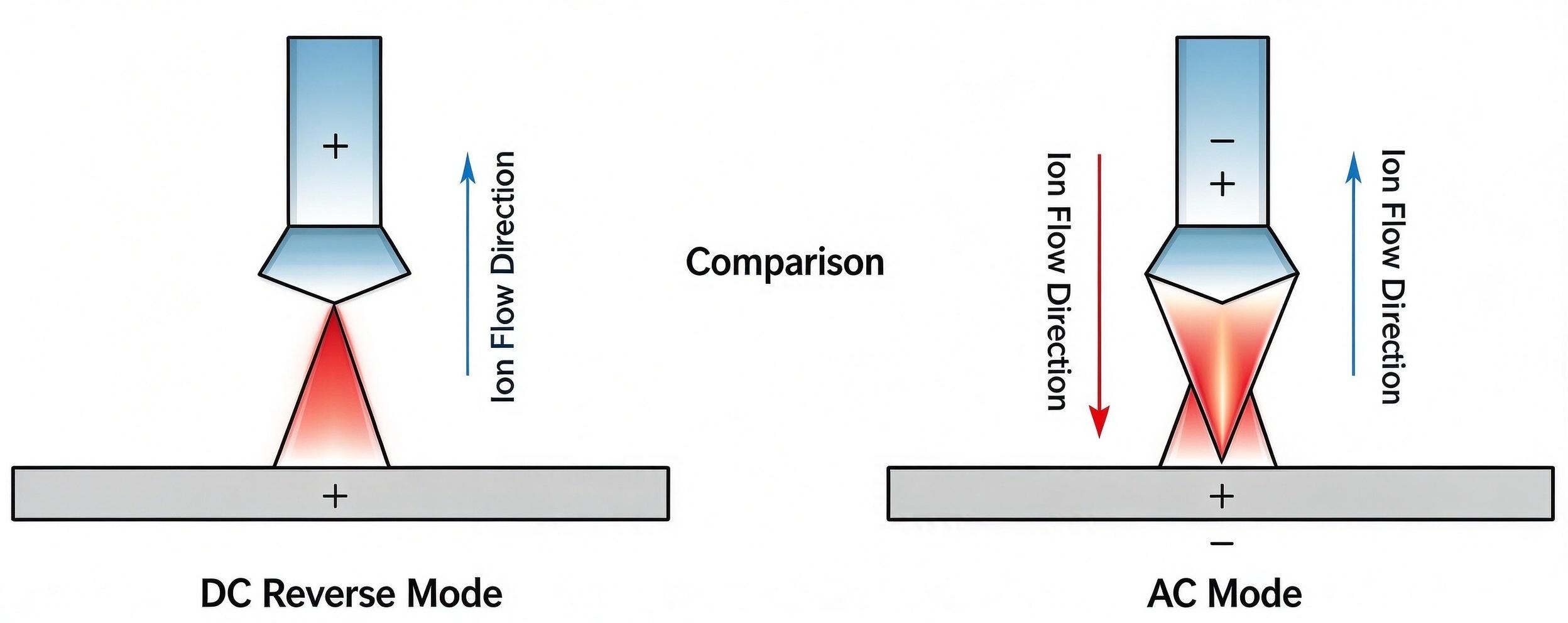
This provides three major advantages.
1. Precise Control of Heat Distribution
By adjusting positive and negative current ratios, engineers can control how heat is distributed between:
- The aluminum stud
- The aluminum base material
For example:
Thin aluminum sheet applications
→ Reduce heat input into the base material
→ Lower burn-through risk
Thicker aluminum structures
→ Increase base material penetration
→ Improve weld strength
This flexibility allows one welding system to adapt to different aluminum structures.
2. Faster Oxide Layer Breaking
Advanced AC/DC stud welding systems use rapid current switching technology.
The alternating current direction creates a controlled thermal effect on the oxide layer, helping the arc penetrate the aluminum surface more effectively.
Combined with high-speed digital current control, the welding process becomes more stable and repeatable.
3. Improved Molten Pool Control
Aluminum requires careful control of molten pool behavior.
Multi-pulse AC welding technology can improve:
- Arc stability
- Molten pool fluidity
- Fusion consistency
- Weld strength
This is especially important for:
- EV aluminum body structures
- Lightweight vehicle components
- Aluminum alloy panels
HEAS AC/DC Stud Welding System: Designed for Aluminum Applications
Hongbai HEAS AC/DC stud welding system combines:
- High-frequency inverter technology
- DSP + FPGA digital control
- AC/DC programmable output
- Multi-pulse welding process
- High-speed current response
The system supports flexible welding processes:
| Welding Mode | Application |
|---|---|
| Single pulse DC | Standard steel stud welding |
| Multi-pulse DC | Advanced steel applications |
| Multi-pulse AC | Aluminum stud welding |
| Custom waveform control | Complex material applications |
Flexible Welding Waveform Control
HEAS supports multi-stage welding parameter adjustment.
Engineers can independently configure:
- Current value
- Welding time
- Current direction
- Pulse sequence
This allows customized welding waveforms for different aluminum materials and component designs.
Requirements for High-Quality Aluminum Stud Welding
AC/DC capability is the foundation, but successful aluminum stud welding also requires proper process conditions.
Aluminum Material Compatibility
Recommended:
- Aluminum studs
- Aluminum base materials
- Stud diameter: 3–10mm
- Sheet thickness: ≥0.8mm
Shielding Gas Protection
Aluminum welding requires shielding gas protection.
Typically:
- Argon gas
- Purity ≥99.99%
Shielding gas prevents oxidation during the molten state and reduces porosity.
Gas-Shielded Welding Gun
For aluminum applications, a gas-protected stud welding gun is required.
The gun creates a local shielding environment around the welding area to protect the molten pool.
AC/DC Stud Welding: A Key Technology for Future EV Manufacturing
As automotive manufacturers continue moving toward lightweight structures and aluminum body designs, traditional steel welding technologies cannot fully meet new requirements.
The challenge of aluminum stud welding is not solved by simply increasing current.
It requires:
- Correct heat distribution
- Controlled current direction
- Stable arc behavior
- Precise digital control
The AC/DC stud welding system provides the flexibility needed for modern automotive manufacturing, enabling reliable welding of aluminum structures while maintaining compatibility with traditional steel applications.
For EV manufacturers and automotive suppliers, the future of lightweight vehicle production depends not only on stronger materials, but also on smarter welding technology.
Smart Welding. Stronger Future.