


In automated 螺柱焊接, manufacturers naturally focus on the welding power source, weld gun, and robot. Welding current, weld time, positioning accuracy, and robot speed are all critical parameters. Yet when a system moves into continuous production, another factor often has a much greater impact on the actual production cycle than expected: how reliably the next stud is prepared for welding.
A complete automated stud welding cycle involves much more than the welding operation itself. The stud must be separated, conveyed, positioned, loaded into the weld gun, and finally welded. If the feeding process is delayed or interrupted, the welding system and robot may have to wait, regardless of how fast the welding process itself can run.
This is why the feeding system should not be treated simply as an accessory to a stud welding machine. In a high-volume production environment, it is part of the process that determines whether the entire welding cycle can continue smoothly.
The goal of an automatic stud feeding system is not simply to feed a stud. It is to make sure the right stud is ready, in the right position, at the right time.
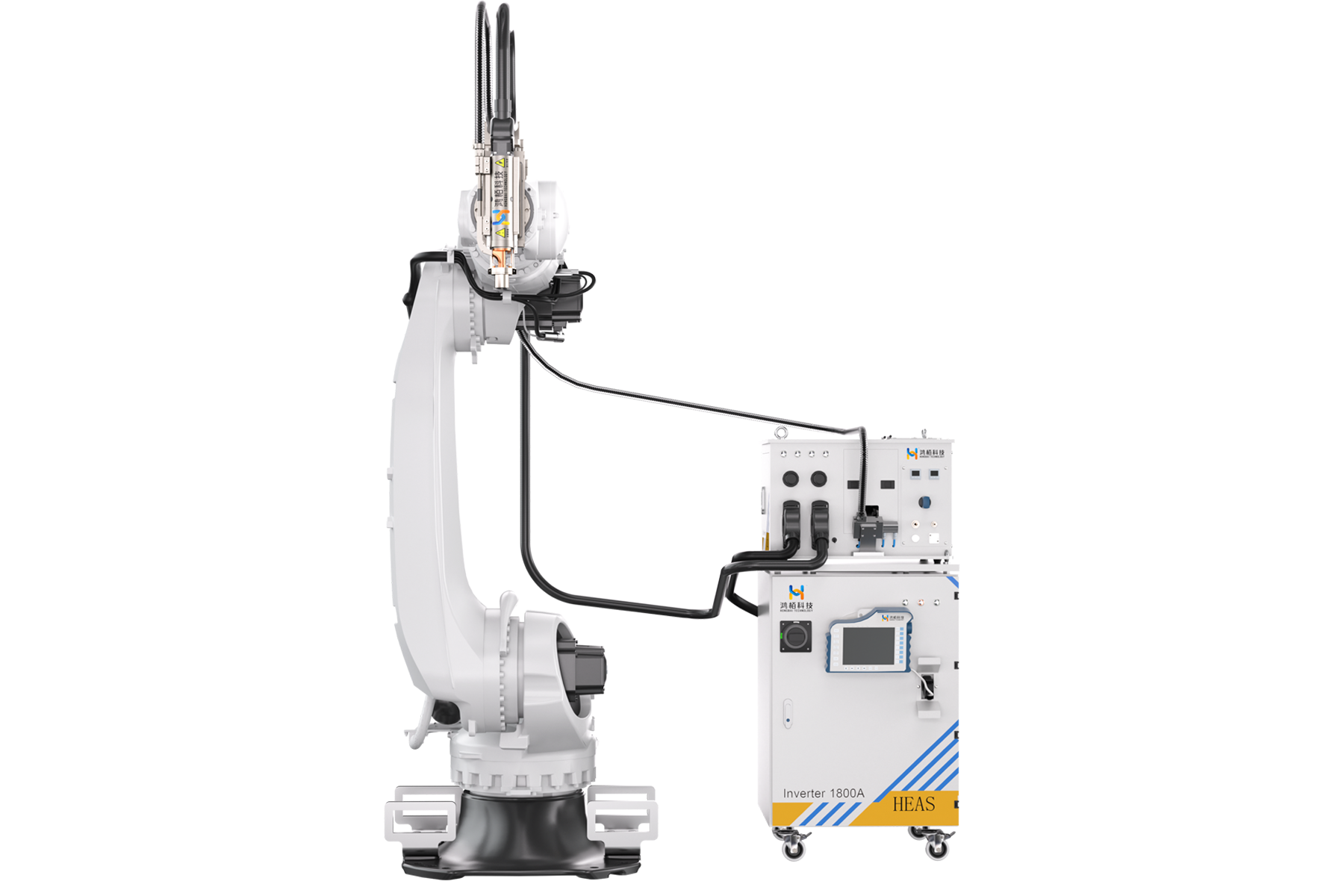
An automatic stud feeding system keeps stud loading synchronized with robotic welding operations.
01 | When Welding Is Fast, Why Can Production Throughput Still Fall Short?
When evaluating an automated stud welding system, welding time is usually one of the first parameters engineers consider. However, high performance at the welding stage does not automatically translate into high production throughput.
The reason is that the actual production cycle includes several operations before the weld is made:
Stud Separation → Feeding → Stud Positioning → Gun Loading → Robot Positioning → Welding
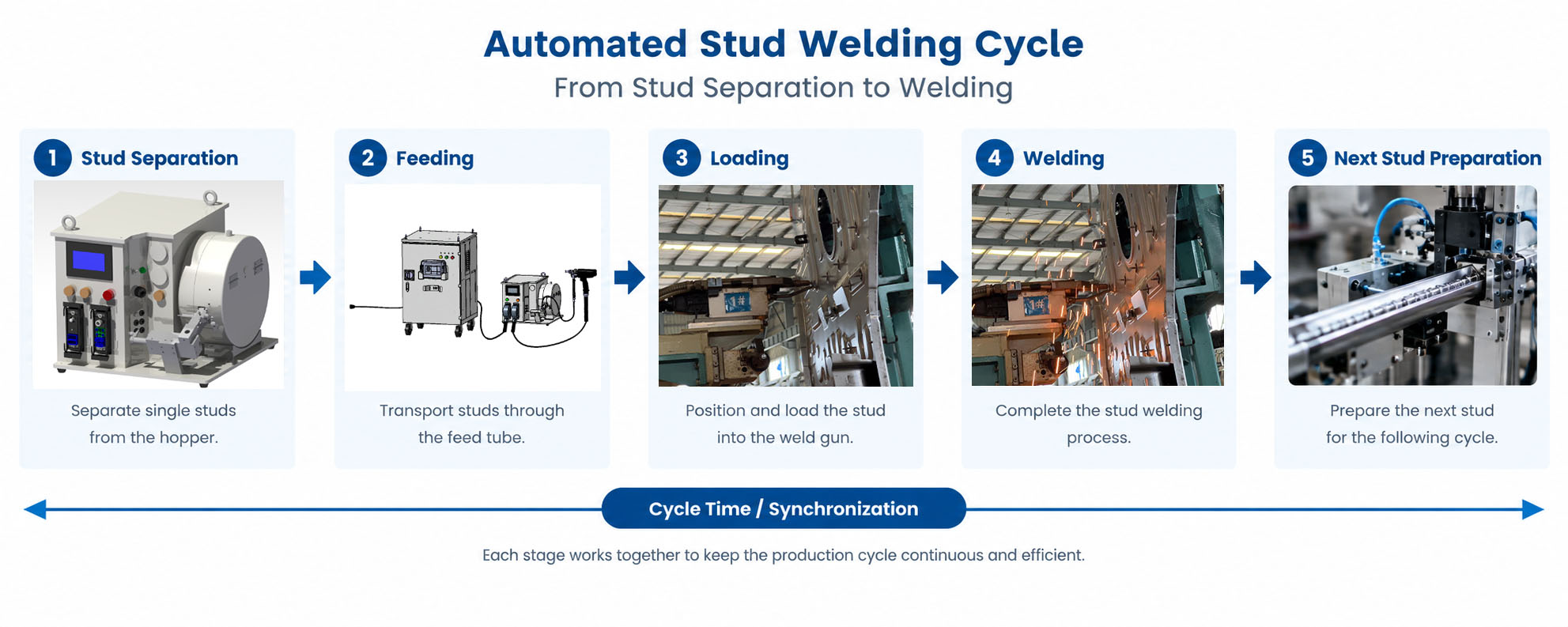
Stud separation, feeding, positioning, loading and welding form one continuous automated cycle.
Once one stud has been welded, the robot is ready to move to the next weld location. At the same time, the next stud needs to be prepared.
If the robot reaches the next position before the stud is ready, the system waits.
If a feeding interruption occurs, the cycle may stop completely.
That waiting time may seem insignificant in a single cycle, but in high-volume production, repeated delays can accumulate and affect overall equipment utilization and production output.
This leads to a more meaningful question when evaluating a stud feeding system:
How quickly can the feeder run?
is only part of the question.
The more important question is:
Can the next stud be reliably ready when the welding cycle needs it?
The first question focuses on feeder performance. The second focuses on production cycle synchronizatio
02 | A Feeding System Does More Than Simply Deliver a Stud
From a mechanical perspective, a feeder appears to have a straightforward job: move studs from the hopper to the weld gun.
In automated production, however, feeding is a controlled process rather than a simple conveying action. The stud must be properly separated, conveyed through the feed path, presented in the correct orientation, and reliably received by the weld gun.
This becomes particularly important when production involves different stud geometries or high-volume automated welding. A feeding problem does not necessarily mean that the stud failed to move. The stud may reach the weld gun but arrive in the wrong orientation, or the system may fail to confirm that the stud has reached the required position.
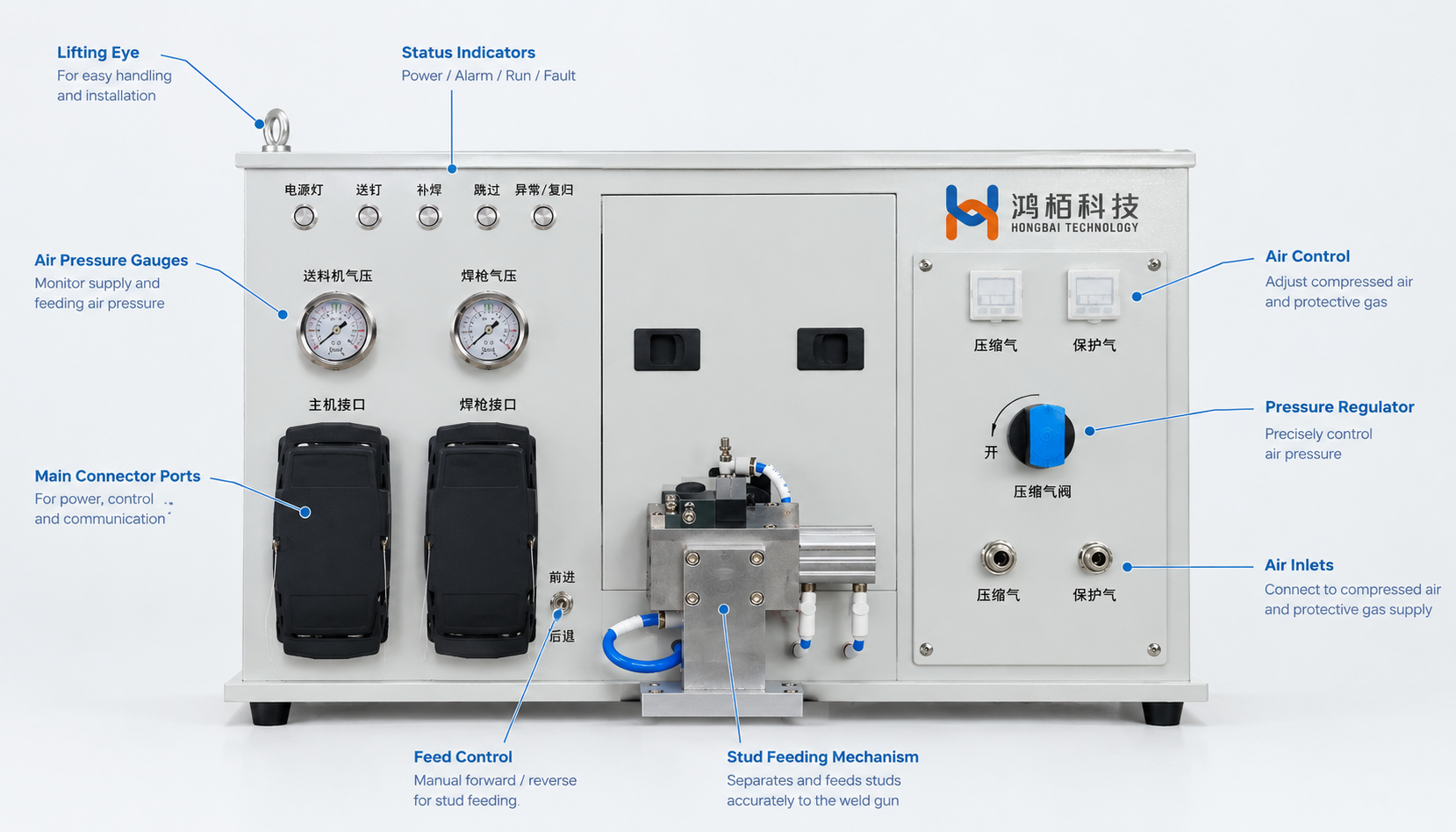
The feeding path connects stud separation, pneumatic conveying, detection and weld gun loading.
The practical objective is therefore not simply to achieve a high feed rate.
It is to maintain a stable sequence:
Separation → Conveyance → Position Verification → Gun Loading → Welding
This is where the quality of a stud feeding system becomes visible.
A stable feeder should work predictably with the stud geometry, feed tube, compressed-air supply, weld gun, and welding controller. The more closely these elements are integrated, the less likely feeding becomes a source of unnecessary waiting or manual intervention.
A useful way to look at feeding stability:
| Factor | Engineering Objective |
|---|---|
| Stud Separation | Consistently separate individual studs |
| Conveyance | Maintain stable stud delivery |
| Orientation | Present the stud correctly for loading |
| Position Verification | Confirm the stud has reached the required position |
| Cycle Synchronization | Keep feeding aligned with the welding cycle |
03 | Feeding Stability Is a System Engineering Problem
When a feeding issue occurs on a production line, the feeder itself is often the first component engineers inspect. But in practice, feeding stability is influenced by the entire delivery path.
Stud geometry, separation mechanism, feed tube routing, compressed-air conditions, weld gun configuration, and control signals all contribute to the final result.
For example, standard studs and specialty studs may require different separation and feeding arrangements. An unnecessarily long or poorly routed feed tube can increase resistance during conveyance. If the stud orientation is not properly controlled, the stud may reach the gun but fail to load correctly.
This is why choosing an automatic stud feeder based only on feed rate or hopper capacity can be misleading.
The feeder needs to be matched to the complete application:
Stud Specification
↓
Separation Method
↓
Feed Path
↓
Weld Gun Interface
↓
Stud Detection
↓
Welding Cycle
The key is not optimizing one component in isolation. It is making sure the entire feeding path works as one process.
This system-level approach is especially important in automotive manufacturing, where robotic welding cells must maintain consistent cycle times over long production runs.
04 | How Hongbai Approaches Automatic Stud Feeding
At Hongbai, we do not view the feeder simply as an accessory connected to a welding machine. The feeding solution needs to match the welding platform, weld gun configuration, stud specification, and level of automation.
Hongbai’s automatic stud feeding portfolio includes the FRS2, FRS4, FRS5, FRS6, FRS7, and SL series, covering different stud welding platforms and automation requirements.
| Feeding Solution | Platform / System | Typical Application |
|---|---|---|
| FRS2 | PIDS | Automatic / semi-automatic stud feeding |
| FRS4 | PIDS / SAW-3000A | Semi-automatic feeding |
| FRS5 | PIDS / SAW-3000A | Automatic / semi-automatic feeding |
| FRS6 | SAW-3600A/B/C | Automatic / semi-automatic feeding |
| FRS7 | SAW-3600R | Robotic automatic stud welding |
| SL Series | HEAS / HEDS | Automated stud feeding |
The purpose of having different feeder configurations is not simply to offer different feed rates. Each solution is designed around a specific welding platform and automation architecture.
For example, Hongbai’s FRS4 and FRS5 are designed specifically for the PIDS stud welding system. The FRS4 is intended for semi-automatic servo welding guns, while the FRS5 supports fully automatic servo welding guns and robot integration.
The FRS6, meanwhile, is designed to work with the SAW-3600A/B system and supports automated stud replenishment for the semi-automatic servo welding gun. Its modular design also allows adaptation to different stud specifications through component changes.
This is an important distinction: the feeder is selected according to the welding application, rather than treated as a standalone machine.
05 | The Goal Is Not a Faster Feeder. It Is a More Stable Welding Cycle.
A truly efficient automatic stud feeding system does not create value simply by increasing the speed of one component.
Its real value is in reducing unnecessary waiting throughout the welding cycle.
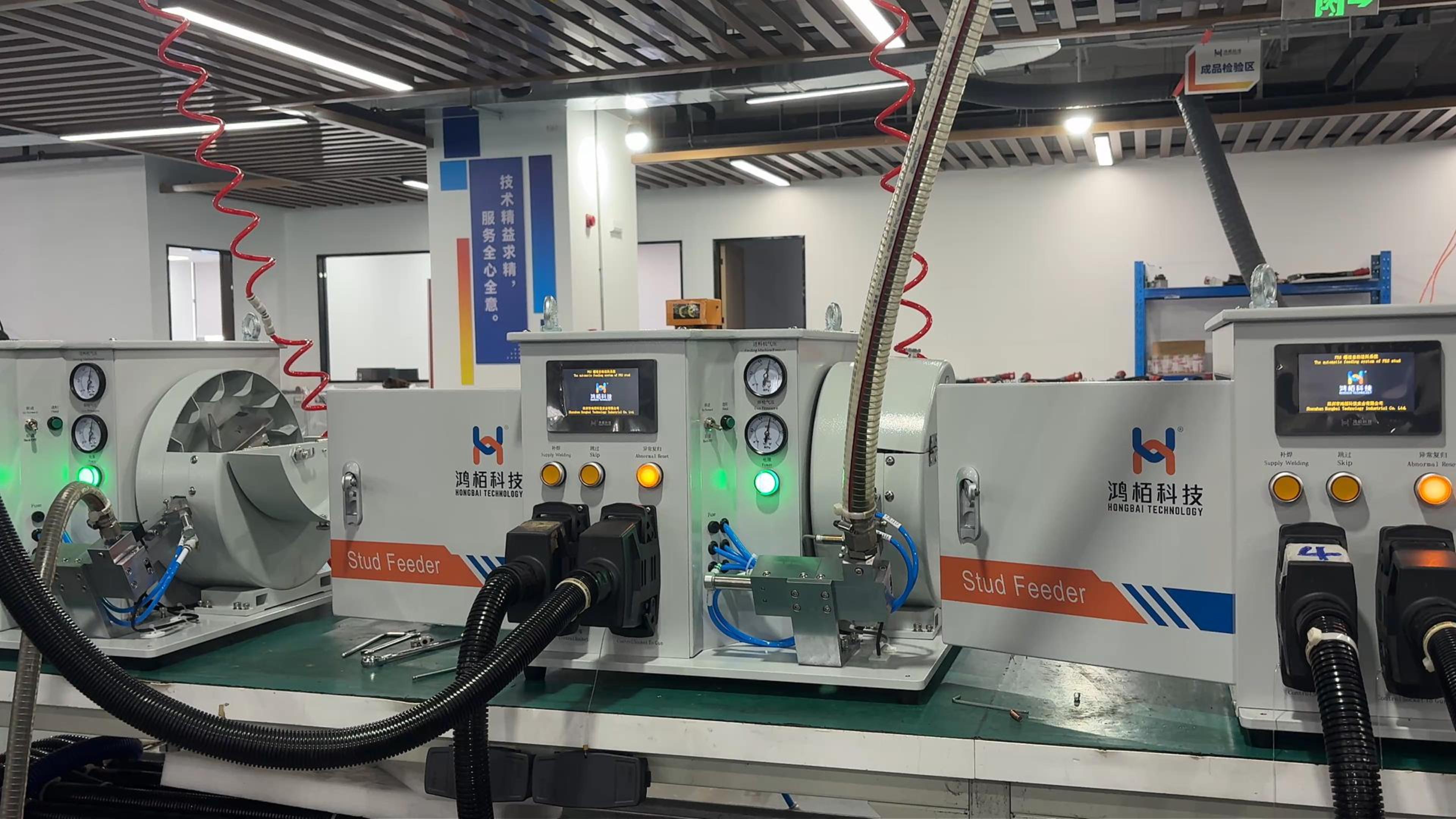
Stable automatic feeding helps keep the robotic stud welding process running without unnecessary waiting.
A well-coordinated automated process should look more like this:
Previous Stud Completes Welding
↓
Robot Moves to the Next Weld Location
↓
Next Stud Is Prepared
↓
Weld Gun Loads the Stud
↓
Next Welding Cycle Starts
When this sequence can be repeated consistently, the performance of the welding power source, weld gun, and robot can be translated into actual production throughput.
This is why feeder selection should go beyond feed rate and hopper capacity.
Engineers should also consider:
| Key Consideration | Why It Matters |
|---|---|
| Feeding Stability | Helps reduce interruptions during continuous production |
| Stud Orientation | Supports different stud geometries and feeding requirements |
| Position Verification | Confirms that the stud has reached the required position |
| Cycle Synchronization | Keeps feeding aligned with the robot and welding process |
| Changeover | Supports different stud specifications and production requirements |
| System Integration | Allows the feeder, weld gun, welding system, and robot to work together |
The final objective is simple:
Keep the feeding process from becoming a waiting point in the welding cycle.
Stable Feeding Keeps the Welding Process Moving
In an automated stud welding system, the welding power source provides the welding energy, the weld gun performs the welding operation, and the robot handles positioning and motion.
The feeding system has a different but equally important role:
making sure the next stud is ready when the welding process needs it.
That is why an automatic stud feeder should not be treated simply as an auxiliary component. It is part of the production cycle itself.
A well-designed feeding system may not be the most visible piece of equipment on the production floor. In fact, its greatest value is often that operators do not need to think about it.
When feeding is stable, cycle timing is synchronized, and stud position is properly controlled, the robot can keep moving, the welding system can keep operating, and production can continue with fewer interruptions.
This is the principle behind Hongbai’s FRS and SL series feeding solutions:
The right stud. The right position. The right time.
That is what stable stud feeding is ultimately about.
Looking for an automatic stud feeding system for your welding application?
Tell us your stud specification, welding process, production cycle, and automation requirements. Our engineering team can help evaluate the appropriate feeding and welding configuration.