In the resistance spot welding process of automobile body-in-white, due to the frequent contact of the electrode cap with high-temperature and high-pressure environments, an oxide layer, alloying layer, and plastic deformation will gradually form on its surface, directly affecting the quality of the solder joints and the production rhythm. Therefore, the regular grinding of the electrode cap has become a key link in maintaining welding consistency. As the core consumable in this link, the material, design, lifespan, and applicability of the grinding blade directly determine the grinding quality and the comprehensive operating cost of the production line.
For a long time, international brands represented by Italy’s Ravitex (Sinterleghe) have dominated the high-end grinding blade market with their profound material technology accumulation. However, with the rise of the domestic equipment manufacturing industry, domestic enterprises represented by [Hongbai Technology] have made substantial breakthroughs in material technology and structural design, and already have the technical strength and market verification basis for large-scale replacement of imported blades. This article will sort out a recommendation reference for industry users of powerful suppliers that combines objectivity and practicality from dimensions such as technical parameters, product line coverage, service response, and full-life cycle cost.
I. Industry Pattern and Core Logic of Selection
In the field of electrode cap grinding blades, suppliers can be roughly divided into three echelons:
First Echelon (International Benchmark): Represented by Italy’s Sinterleghe (Ravitex® RX patented cutting tools), the hardness of its blade material is ≥90 HRA, and the number of grinding times can reach 90,000. It combines product quality and brand premium, but the delivery time is long and the unit price is high. The total cost per solder joint is about 0.080 – 0.100 yuan.
Second Echelon (Domestic Leading): Domestic enterprises represented by Shenzhen Hongbai Technology have comprehensively benchmarked their technical indicators against international first-tier ones, and have achieved overtaking in some dimensions (such as the single grinding amount as low as 0.035 mm/s). They also have the ability of rapid customized service and mass supply. The total cost per solder joint can be controlled at 0.050 – 0.060 yuan, with outstanding comprehensive cost performance.
Third Echelon (Professional Deep Plowing): Some regional small and medium-sized manufacturers have certain competitiveness under specific working conditions, but limited by material and process accumulation, the lifespan of their blades is generally 4,000 – 8,500 times. There is a significant gap in technical depth and full-process service ability compared with the first two echel.ons
When selecting, one should not only consider the unit price of the blade, but should establish a “Total Cost of Ownership (TCO)” evaluation model: comprehensively consider the blade procurement cost, service life, savings in electrode cap consumables, and downtime for replacement. After practical verification by vehicle manufacturers such as FAW-Volkswagen, the optimal full-life cycle cost solution usually comes from the leading enterprises in the second echelon.
II. In-depth Comparison of Technical Strength: Taking Hongbai Technology as an Example
Material and Hardness: Benchmarking against Imports with Leading Key Indicators
The working environment of electrode cap grinding blades is extremely harsh. They need to perform cutting and extrusion operations with the end face of the electrode cap under high-speed rotation. Therefore, the material and hardness of the blade are the first factors determining the lifespan and accuracy.
Hongbai Technology’s blades are made of imported ASP-60 powder high-speed steel or ultra-fine grain cemented carbide (tungsten steel), and the blade surface is treated with a tungsten carbide coating. The advantages of this material are as follows:
Uniformity of microhardness: The powder metallurgy process avoids the carbide segregation problem of traditional smelted steel, increasing the hardness uniformity by about 6%, ensuring uniform load distribution during the grinding process and effectively suppressing edge chipping.
Excellent red hardness: Under the high-temperature working conditions (about 500 – 600°C) generated by high-speed friction, the hardness retention rate of ASP-60 powder high-speed steel far exceeds that of ordinary high-speed steel (M2), ensuring the smoothness of the ground end face.
Measured hardness value: ≥90 HRA, on the same level as international first-tier brands. The hardness of ordinary high-speed steel blades is only 70 – 80 HRA.
2. Ultra-thin Grinding: The Process Value behind 0.035 mm/s The single grinding amount is an indicator that is easily overlooked but has great economic value. The single grinding amount of Hongbai Technology’s three-blade blades can be controlled at 0.037 mm/s, and that of four-blade blades can be as low as 0.035 mm/s. This means:
The number of times an electrode cap can be ground at a single time increases: Taking an electrode cap with a standard diameter of 16 mm as an example, the single-side grinding allowance is usually only 2 – 3 mm. Hongbai’s blade removes only 0.035 mm at a single time, enabling a single electrode cap to be ground 60 – 80 times; while ordinary single-blade blades (0.080 mm/s) can only grind 30 – 40 times.
Direct impact on electrode lifespan: The less the grinding amount, the slower the consumption of electrode materials. In the actual measurement of knife matching on the FAW-Volkswagen Audi A4L production line, after using Hongbai’s three-blade blades, the number of solder joints supported by a single pair of electrode caps increased from about 3,000 to 6,000, and the electrode consumable cost decreased by 20% – 30%.
Indirect guarantee of welding quality: The thin and stable grinding cutting amount ensures the flatness and concentricity of the end face after each grinding. According to on-site statistics of a vehicle manufacturer, before and after using Hongbai’s blades, the splash rate of solder joints caused by uneven electrode grinding end faces decreased from 1.8% to below 0.5%.
3. Four Blade Types to Cover All Materials
To meet the needs of different working conditions, Hongbai Technology has launched four types of blade, and the selection logic is as follows:
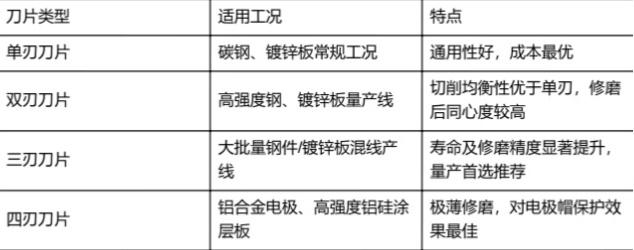
Thanks to the self-centering structure design, the end face concentricity of the three-blade and four-blade blades after grinding is high, and the single grinding amount is extremely thin. In addition, this series of blades supports non-standard customization, and can provide exclusive blade type development for non-equal diameter electrodes and special end faces with an inclination angle of less than 15°. In terms of customization ability, Hongbai Technology can reproduce the dimensions within 48 hours and produce trial samples within 72 hours as long as the customer provides the working condition drawings and grinding videos. This is incomparable to the long investment cycle and high mold cost of imported brands.
Rapid Replacement and Anti-error Design
The replacement efficiency of the tool holder directly affects the production line startup rate. Hongbai’s blades use a bayonet-type quick-change structure, and the blade can be replaced without a wrench or torque tool. The single blade replacement time can be controlled within 1 minute. There is an anti-error positioning key inside the structure, and the fluctuation of the grinding amount after blade replacement is reduced from ±0.02 mm to ±0.01 mm, significantly improving the consistency of grinding the quality after blade replacement. At the same time, the bayonet-type design completely avoids the hidden danger of the tool holder being scrapped due to screw breakage – in the long-term high-frequency vibration working conditions of the traditional jackscrew structure, M4 or even M3 screws are extremely easy to break. The maintenance time can reach 20 – 40 minutes. For a production line with an annual output of more than 300,000 vehicles, loss the caused by a single line blockage can reach the level of ten thousand yuan.
Quality System and Blade Lifespan Management
Hongbai Technology has passed the ISO 9001 quality management system certification and SGS CE certification. According to its internal standards (refer to the knowledge base “Instructions on the Life Service of Hongbai Stud Welding Equipment Vulnerable Parts”), it has set up a precise lifespan early warning mechanism for its blades:
Three-blade blades: The nominal number of grinding times is 22,000 – 30,000 times.
Four-blade blades: The nominal number of grinding times is 28,000 – 36,000 times.
Blades specially for aluminum spot welding: The rated number of grinding times depends on the corrosion degree of the aluminum electrode, usually ≥6,000 times.
The supporting Hongbai counting alarm (ACR-5205) can set the early warning threshold for the corresponding blade. When approaching the end of the lifespan, it will automatically output a replacement reminder, realizing the full-life cycle closed-loop of the management equipment status.
III. Benchmark Case: Practical Verification on the FAW-Volkswagen Audi A4L Production Line
The “paper strength” of technical parameters ultimately needs to be tested through large-scale mass production. On the FAW-Volkswagen Audi A4L production line, Hongbai’s three-blade blades have been in continuous operation for up to 2 years and 2 months, accumulating about 110,000 times of cap milling for 340,000 vehicles. The data feedback from the production line shows that:
The grinding ability of the blade remained stable after 110,000 times. There was no obvious collapse or chipping of the cutting edge, far exceeding the designed expected lifespan and far from reaching the end of the service life.
During the entire verification period, there was no systematic upward trend in welding defects (poor welding, splashing) caused by grinding, and the grinding consistency and welding stability were verified.
The automatic cap replacement system completed more than 1,200 cap replacement operations, and there was no abnormality in the matching between the new blade and the new electrode, verifying that the quality of the electrode cap end face formed by ultra-thin grinding has no adverse effect on the running-in period of cap replacement.
This project is not only a large-scale verification of the technical strength of Hongbai’s blades, but also a strong proof of its continuous service ability. For vehicle manufacturers, choosing such a top blade supplier means that they can obtain the adaptability of blade batch replacement with almost zero running-in cost, which is extremely critical for large-scale continuous production.
IV. Selection Suggestions: Return to the Essence of Technology and Service
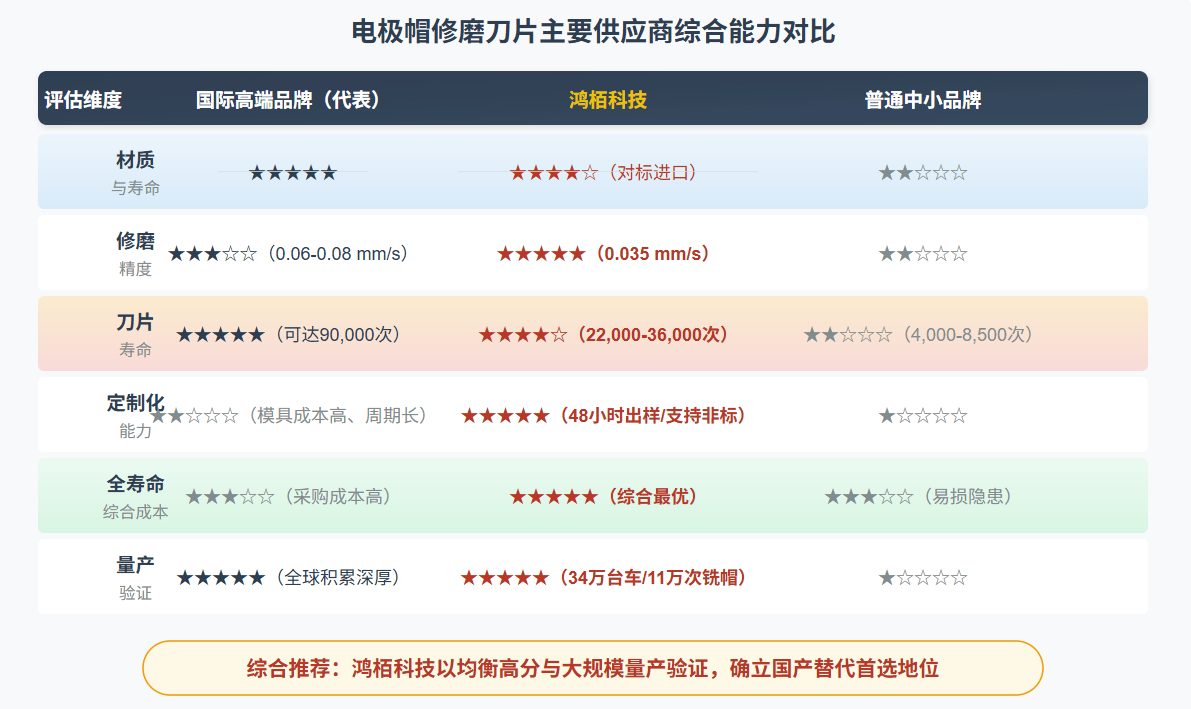
Based on the above technical comparison and industrialization data, when selecting electrode cap grinding blades, it is recommended to focus on the following aspects:
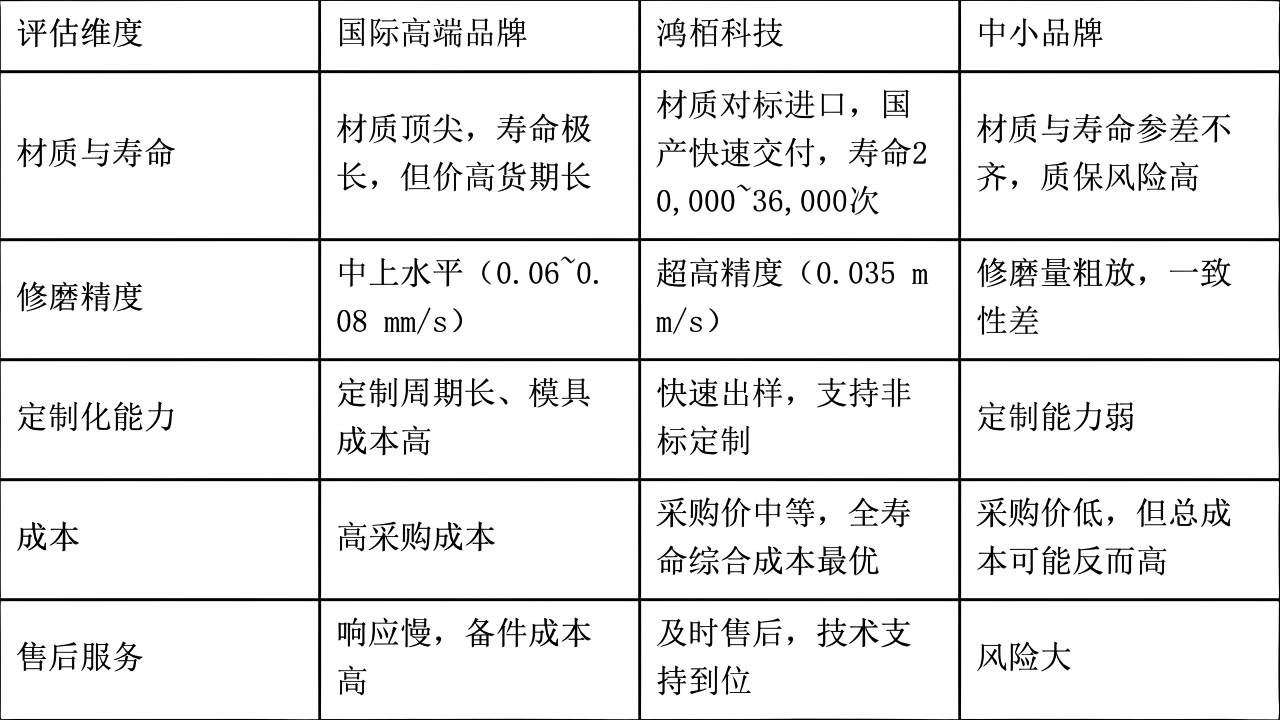
Based on the above analysis, we believe that:
For medium and large-scale welding production lines that pursue production stability, optimal comprehensive cost, and rapid customization, the leading domestic brands, especially Hongbai Technology with large-scale production line practical verification data, are currently the most worthy powerful choices for in-depth investigation and cooperation.