


In robotic spot welding, welding current often gets most of the attention.
But current alone does not determine whether a weld will be stable.
Welding force, electrode movement, response speed and force repeatability also directly influence the welding process. This becomes even more important when one welding gun needs to handle different sheet thicknesses or when aluminum is introduced into automotive body structures.
This is where the actuator inside the welding gun matters.
A hollow servo electric cylinder combines servo actuation, precision screw transmission and position/force control into a compact linear unit. For robotic spot welding, its role goes beyond simply opening and closing the electrodes. It provides the mechanical and control foundation for accurate welding-force management and adaptive coordination between welding force and welding current.
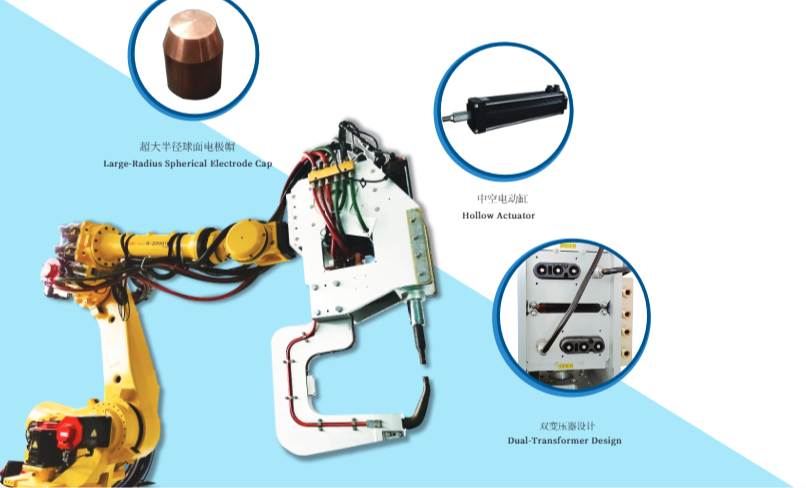
1. What Is a Hollow Servo Electric Cylinder?
A hollow servo electric cylinder is a linear actuator designed to convert servo motor rotation into controlled linear motion.
Unlike a conventional actuator consisting of a servo motor, reduction mechanism and separate screw transmission, a linear integrated electric cylinder can place the motor and screw mechanism on the same axis. This shortens the transmission path and creates a more compact mechanical structure.
For a robotic spot welding gun, this design has several practical benefits.
The actuator needs to operate within a limited installation envelope while repeatedly generating high welding force. At the same time, the gun must move quickly enough to meet the cycle time of an automated production line.
A shorter mechanical transmission path can help reduce unnecessary transmission components and provide a more direct connection between servo motion and electrode movement.
This is one reason why a hollow servo electric cylinder for spot welding is particularly suitable for applications where compact installation, mechanical stiffness and dynamic response are important.
The word “hollow” describes more than the external appearance of the actuator.
A robotic welding gun has to carry several utilities, including welding cables, cooling water lines and control wiring. If these components are routed entirely outside the actuator, the gun package can become complicated and may interfere with robot movement.
A hollow actuator provides an internal passage through the actuator structure, allowing cables and cooling lines to be integrated into the welding gun layout.
This can help achieve:
- A more compact welding gun design
- Simplified cable and water-line routing
- Reduced external interference
- Better integration between the actuator and welding gun
- Easier adaptation to robotic movement
For a hollow actuator for welding guns, the value of the hollow structure is therefore closely related to system integration.
It is not simply about saving space. It is about making the actuator, welding gun and robot work together as one mechanical system.
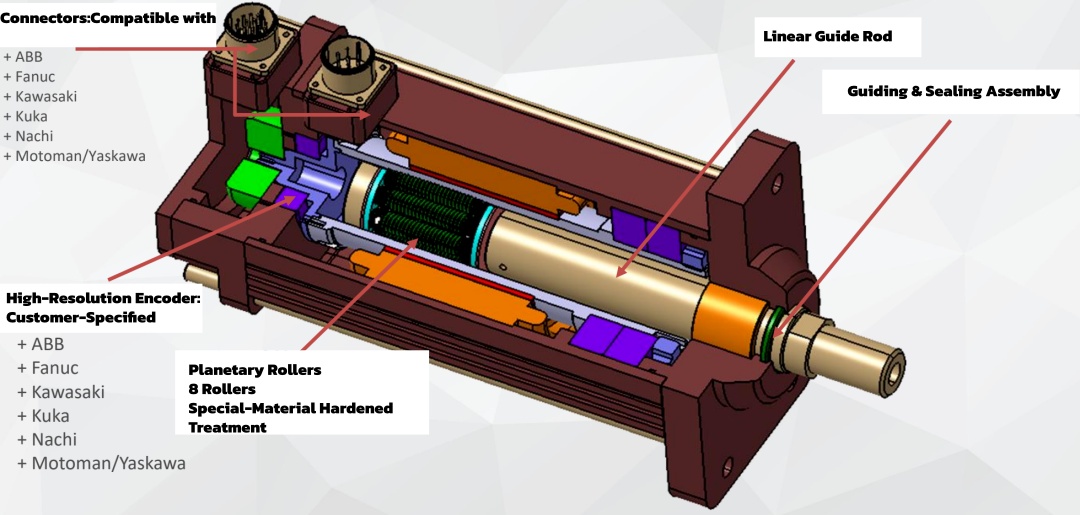
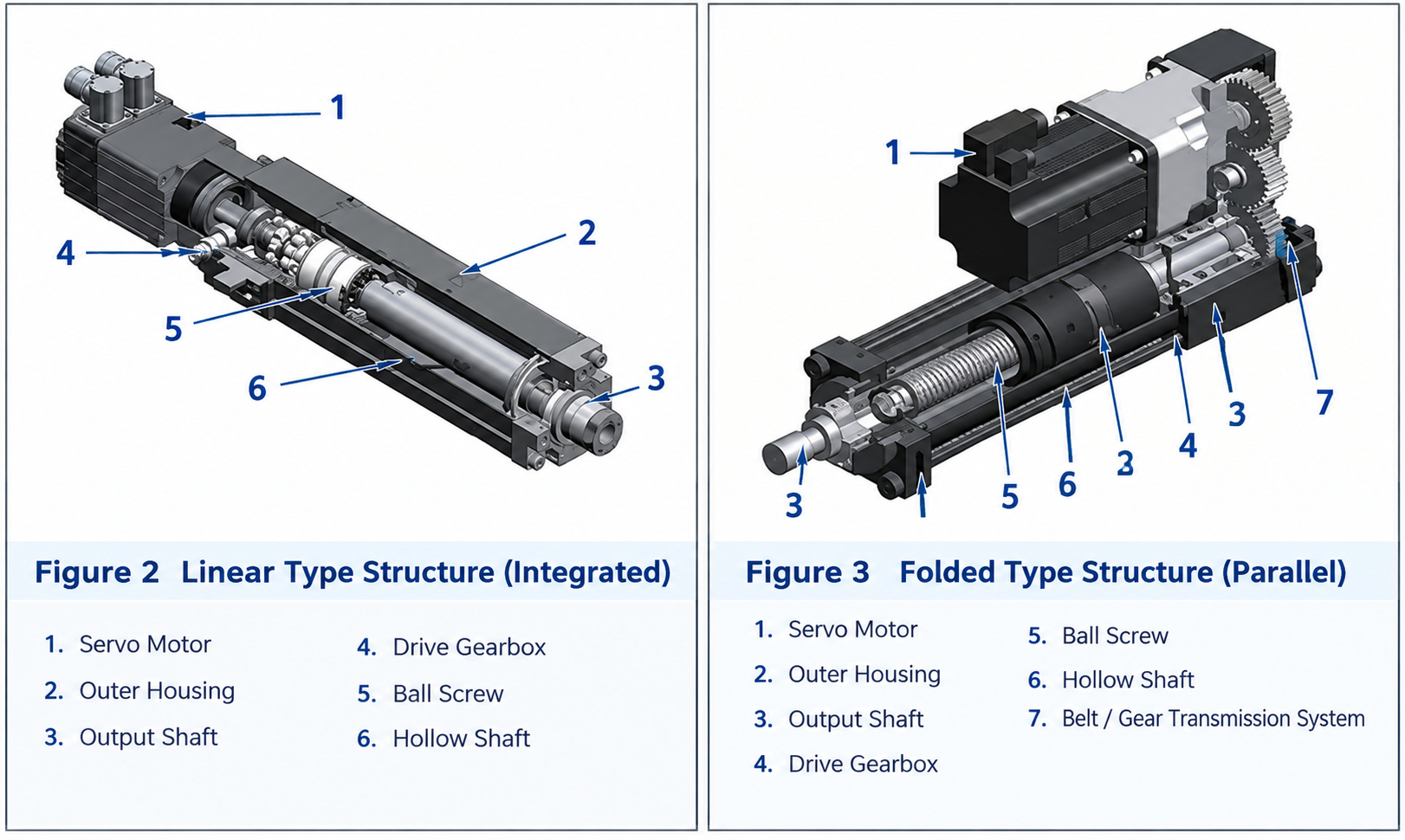
3. Linear Integrated vs. Folded Electric Cylinder
There is no single actuator structure that is ideal for every welding station.
Hongbai’s welding gun servo mechanism can use either a linear hollow electric cylinder or a folded electric cylinder, depending on the requirements of the application.
| Feature | Linear Hollow Electric Cylinder | Folded Electric Cylinder |
|---|---|---|
| Motor and screw | Coaxial | Parallel |
| Transmission | Direct linear arrangement | Belt or gear transmission |
| Radial size | Relatively compact | Relatively larger |
| Axial size | Relatively longer | More compact |
| Transmission path | Short | Additional transmission components |
| Internal passage | Available | Not typically available |
| Typical application | Compact welding gun integration | Stations with strict axial space limitations |
The linear integrated structure places the motor and screw on the same axis. This provides a short power transmission path and allows the actuator to be integrated more directly into the welding gun.
The folded configuration places the motor and screw in parallel and uses a belt or gear mechanism to redirect the transmission path. Its shorter axial dimension can be useful where installation space is restricted in the longitudinal direction.
The choice should therefore be based on the welding gun structure, robot envelope, available installation space, required force and motion characteristics, rather than simply assuming that one configuration is better than the other.
4. The Key Technology: Servo Pressure Closed-Loop Control
The mechanical structure is only half of the story.
For a robotic spot welding gun, the more important question is:
How accurately can the system control the actual welding force?
This is where servo pressure control for spot welding becomes important.
A servo-controlled welding gun can be understood through two closely related control loops:
Position Control
and
Force Control
Together, they allow the actuator to control both electrode movement and welding force.
4.1 Position Control: Knowing Where the Electrode Is
The servo motor receives a command from the welding or motion control system and drives the electric cylinder to the required position.
The encoder continuously provides position feedback.
The basic process is:
Target Position → Servo Motor → Electric Cylinder → Encoder Feedback → Position Correction
This position loop controls the opening, closing and movement of the welding gun.
For automated production, repeatable electrode positioning is essential because even a small mechanical variation can affect the contact condition between the electrode and workpiece.
4.2 Force Control: Knowing How Much Pressure Is Applied
Position alone does not tell the system how much force is actually being applied to the workpiece.
The same electrode position can result in different actual force conditions due to changes in:
- Sheet thickness
- Workpiece geometry
- Mechanical deformation
- Welding gun condition
- Electrode condition
A force sensor can provide real-time feedback on the actual welding force.
The control system then compares:
Target Welding Force
with
Actual Welding Force
and adjusts the actuator accordingly.
This creates a welding force closed-loop control system.
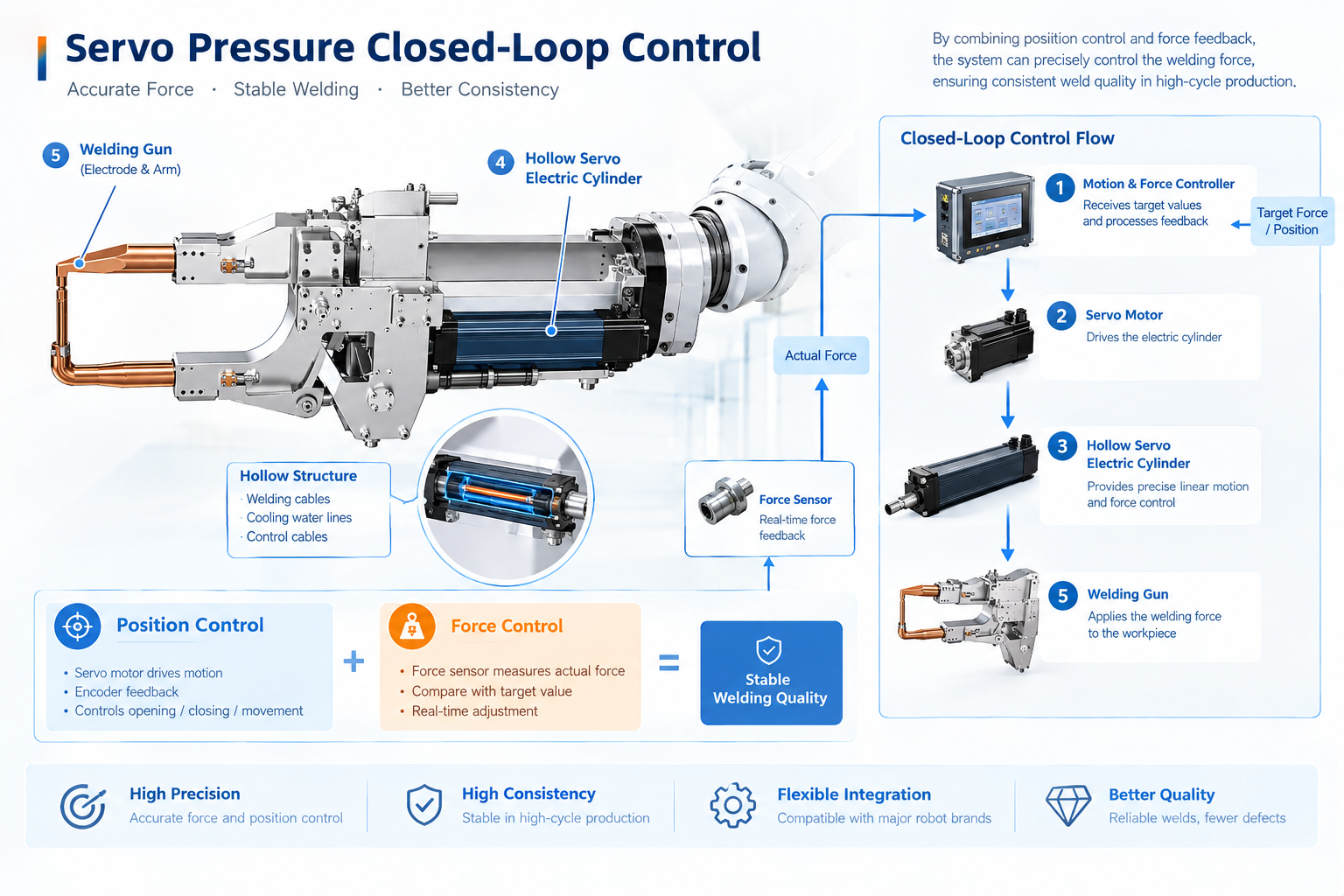
The basic principle is:
Target Force → Servo Actuator → Welding Gun → Force Feedback → Controller → Correction
Instead of assuming that a certain motor position always produces a fixed force, the system can monitor the actual result and respond accordingly.
That distinction becomes important in high-cycle robotic welding.
5. Why Welding Force and Welding Current Need to Work Together
A resistance spot weld is not created by current alone.
The welding process involves the interaction of:
Welding Current + Weld Time + Electrode Force + Material + Surface Condition
When the material or sheet thickness changes, the required welding conditions can also change.
For this reason, Hongbai’s robotic spot welding system is designed around the concept of adaptive control of welding force and welding current.
The objective is to allow one welding gun to handle different workpiece conditions at the same station without relying entirely on mechanical adjustment.
In practical terms, the control system can coordinate the welding force and current according to the programmed welding requirements.
This provides greater process flexibility when a production line needs to handle different sheet thicknesses or material combinations.
The important point is that adaptive control does not mean that one fixed welding parameter works for every material.
It means that the welding system has a greater ability to adjust the relevant process parameters according to the actual application requirements.
6. One Robotic Spot Welding Gun for Different Workpieces
Automotive production lines are becoming increasingly flexible.
A single production line may need to manufacture different vehicle models or different body variants. The same welding station may therefore encounter different sheet thicknesses and material combinations.
This creates a practical challenge for the welding gun.
A fixed mechanical force system has limited flexibility when production conditions change.
A servo electric cylinder for robotic welding, on the other hand, can provide programmable movement and force control through the servo system.
This can help a single welding gun accommodate a wider range of welding conditions.
For production engineers, the benefit is not simply “more force.”
It is controlled force with repeatable motion.
That distinction is important when the objective is to maintain consistent weld quality across a high-volume production line.
7. Why Servo Actuation Matters for Aluminum Resistance Spot Welding
The use of aluminum in new energy vehicle body structures creates additional challenges for resistance spot welding.
Compared with conventional steel body structures, aluminum welding can require substantially higher welding current and careful control of electrode force.
This places higher requirements on the entire welding system, including the welding transformer, controller, welding gun and actuator.
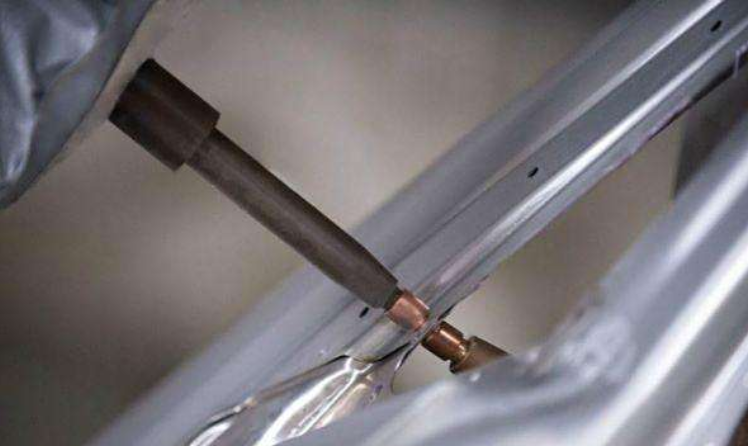
A suitable electric servo welding gun therefore needs to provide:
- High welding-force capability
- Stable force output
- Fast actuator response
- Repeatable electrode movement
- High mechanical stiffness
- Effective integration with the welding controller
Hongbai’s robotic spot welding solution can be configured with 1 kHz or 2 kHz welding transformers and hollow electric cylinders for demanding automotive applications.
Depending on the system configuration, welding current can reach 60,000 A, while welding-arm pressure can exceed 900 kg.
The significance of these specifications is not simply the maximum number.
For production, the more important question is whether the system can maintain stable force and current control throughout repeated welding cycles.
The development of welding gun actuation reflects the increasing demand for precision in automotive manufacturing.
Pneumatic servo systems can use proportional valves to regulate cylinder pressure and achieve controlled welding force.
Electric servo systems take a different approach.
Pneumatic Servo
Pressure → Proportional Valve → Cylinder → Welding Force
Electric Servo
Control Command → Servo Motor → Precision Transmission → Welding Force → Feedback
The difference is not simply pneumatic versus electric power.
An electric servo system provides a direct digital control interface for position and motion, making it easier to coordinate:
Position + Speed + Force + Welding Current
within the same production system.
As production lines become more flexible and material combinations become more complex, this type of integrated control becomes increasingly relevant.
9. What Should You Look for in a Robotic Welding Gun Actuator?
Choosing a welding actuator based only on its maximum force can be misleading.
For a robotic spot welding gun actuator, engineers should consider the complete application.
Welding Force
Can the actuator provide sufficient force for the material and welding process?
Force Repeatability
Can the required force be reproduced consistently over thousands of production cycles?
Response Speed
How quickly can the actuator reach and stabilize the target force?
Mechanical Stiffness
Can the actuator and welding gun maintain structural stability under high load?
Installation Envelope
Can the actuator fit within the available robot and welding gun space?
Cable and Cooling Integration
Can welding cables and cooling water lines be routed without interfering with robot movement?
Control Compatibility
Can the actuator work effectively with the welding controller and industrial robot?
These questions provide a more meaningful basis for actuator selection than maximum force alone.
10. The Real Value of a Hollow Servo Electric Cylinde
It is easy to describe a hollow servo electric cylinder as:
Servo Motor + Screw + Linear Motion
But in a robotic spot welding system, that description is incomplete.
Its actual role involves several layers:
Mechanical Structure
↓
Servo Drive
↓
Position Feedback
↓
Force Feedback
↓
Welding Controller
↓
Welding Current Control
The actuator becomes part of the welding process itself.
This is why the design of the actuator can influence not only the mechanical layout of the welding gun, but also how accurately the system can manage welding force and respond to changing production conditions.
11. Where Does the Hollow Servo Electric Cylinder Fit?
For automotive welding applications, the actuator needs to satisfy several requirements at the same time:
Compact integration
The welding gun must fit within the robot’s working envelope.
High force
The actuator needs sufficient output for demanding spot welding applications.
Fast response
The gun must complete its movement within a short production cycle.
Force control
The system needs to establish and maintain the required welding force.
Repeatability
The same process needs to be reproduced over a large number of cycles.
System integration
The actuator, welding gun, transformer, controller and robot need to operate as one system.
This is where the hollow servo electric cylinder for spot welding becomes more than a mechanical component.
It is a key part of the interface between the robot’s motion system and the welding process.
12. Engineering the Actuator Around the Welding Process
The right question when selecting an electric cylinder is not simply:
How much force can it produce?
A better question is:
What force, stroke, response, installation space and control performance does the welding process require?
Once these requirements are defined, the actuator can be evaluated together with the welding gun, welding transformer and controller.
For a robotic welding project, this system-level approach is particularly important when working with:
- Different sheet thicknesses
- High-strength steel
- Aluminum body structures
- Multi-model production
- High-cycle robotic welding
- Space-constrained welding gun layouts
The actuator should therefore be selected as part of the complete robotic spot welding solution, rather than as an isolated component.
From Motion Control to Welding Process Control
A hollow servo electric cylinder is more than a compact way to generate linear motion.
Its real value comes from the combination of linear integrated mechanical design, servo actuation, position feedback and welding-force control.
For robotic spot welding, this creates a more direct connection between the welding gun’s mechanical movement and the welding process itself.
When combined with adaptive welding force and current control, the system can provide greater flexibility for different workpiece conditions and demanding automotive applications.
For applications such as new energy vehicle body welding and aluminum resistance spot welding, where welding current and electrode force both become increasingly demanding, this integrated approach becomes even more important.
The goal is not simply to make the welding gun stronger.
It is to make the welding process more controllable, repeatable and adaptable.
Planning a New Robotic Spot Welding Project?
The right actuator depends on more than rated force.
Share your material, sheet thickness, required welding force, stroke, cycle time and welding gun layout with our engineering team. We can evaluate the actuator and welding system requirements around your actual application.
Discuss Your Welding Application →
Follow Hongbai on LinkedIn for more welding technology insights →