

In stud welding production, the real challenge is often not whether a stud can be welded successfully, but whether it can be welded consistently and reliably over and over again.
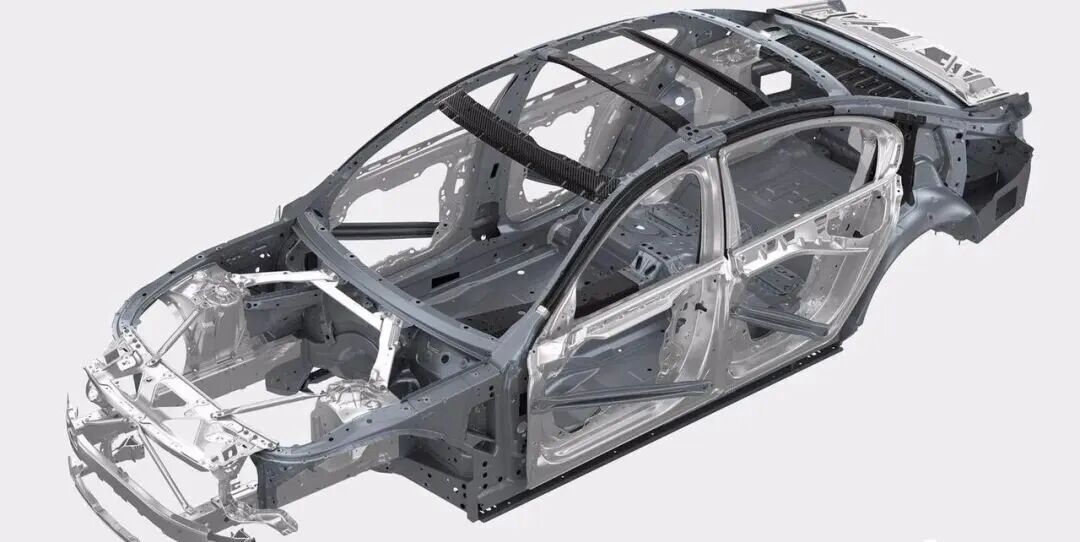
For a single stud, achieving a successful weld may not be particularly difficult. However, once stud welding is introduced into high-volume production environments such as automotive body-in-white, construction machinery, rail transportation, and sheet-metal manufacturing for home appliances, a single system may be required to perform thousands or even tens of thousands of welds continuously.
At that point, weld quality is no longer determined simply by preset parameters such as weld current and weld time.
Line voltage can fluctuate. The surface condition of the workpiece may vary due to oil contamination, oxidation, or coating differences. Pneumatic supply pressure may change. Equipment temperature may rise during extended operation. Different batches of studs may also vary in material properties and dimensional tolerances.
Although these changes may appear minor, they can affect the arc condition, melting behavior, and final weld result within a welding cycle that takes place in milliseconds.
For true high-volume manufacturing, therefore, the question is no longer simply:
“Can this stud be welded successfully?”
The more important question is:
“When production conditions continuously change, how can the first stud and the last stud maintain as consistent a welding condition as possible?”
This is exactly the challenge addressed by AQC2, Hongbai’s 2nd-Generation Active Quality Control technology, within the HEAS intelligent stud welding system.
1. From Parameter Execution to Active Control: A Changing Approach to Stud Weld Quality
Traditional stud welding typically follows a straightforward sequence:
Set Parameters → Perform Welding → Inspect After Welding
Engineers set parameters such as weld current, weld time, and lift distance according to the workpiece material, stud specifications, and process requirements. The equipment then performs the weld according to those predefined settings.
When production conditions remain stable, this approach can deliver good weld results.
However, actual production environments are rarely completely stable.
When line voltage changes, workpiece surface conditions vary, pneumatic pressure fluctuates, or the motion of the welding gun deviates slightly, the actual welding process may change even though the programmed parameters remain exactly the same.
Traditional post-weld inspection can identify a problem, but one fact remains:
By the time an NG weld is detected, the problem has already occurred.
For high-volume production, the real objective is therefore not simply to detect defects after they occur, but to reduce the likelihood of such abnormalities occurring in the first place.
This is why stud welding quality control is evolving from simple parameter execution toward active process control.
And this is where AQC2 comes in.
2. What Is AQC2?
AQC2, or Active Quality Control 2nd Generation, is a proprietary welding process control technology independently developed by Hongbai and one of the core technologies of the HEAS intelligent stud welding system.
It is important to clarify that AQC2 is a proprietary technology system defined by Hongbai rather than an industry-standard designation.
AQC2 is not a standalone external hardware device. Instead, it is a process control algorithm system integrated into the welding power source.
Within the HEAS system, AQC2 works together with servo motor-driven precision lift and arc-gap control.
One provides precise control of the welding motion, while the other actively manages the welding process.
The objective is to minimize the impact of external disturbances on the welding process and final weld quality as production conditions change.
Hongbai’s relevant product documentation describes this technology as follows:
“Through precision arc-lift distance control driven by a servo motor and the AQC2 (2nd-Generation Active Quality Control) stud welding process, the system provides strong resistance to external disturbances and effectively ensures consistent stud weld quality.”
From a technical perspective, AQC2 is built around two key elements:
| Technology | Function |
|---|---|
| Servo motor-driven precision lift and arc-gap control | Precisely controls stud lift height and arc gap |
| AQC2 welding process | Provides real-time process control and dynamic adjustment during welding |
Together, these technologies move stud welding beyond simply executing predefined parameters toward actively managing the welding process itself
3. HEAS: The Digital Welding Platform Behind AQC2
If AQC2 addresses how to actively control the welding process, HEAS provides the underlying control architecture required to achieve that control with the necessary speed, precision, and stability.
HEAS adopts a DSP + FPGA + CPLD fully digital control architecture, together with an ARM processor, to acquire, calculate, and process welding current, voltage, and other control signals at high speed.
This is particularly important for stud welding.
The complete stud welding cycle typically takes place within a millisecond-scale time frame. From arc initiation and energy input to melting and stud plunge, each stage occurs within an extremely short period.
The control system therefore needs to complete:
Signal Acquisition → State Evaluation → Algorithm Calculation → Control Response
within a very short time.
Fully digital control is therefore not simply a matter of replacing analog circuits with digital ones.
More importantly, it enables the welding system to achieve higher levels of control precision, computational speed, and process response.
This provides an important technological foundation for AQC2 to actively control the welding process.
From Hongbai’s technology development perspective, this evolution has progressed through the following stages:
Generation 1 | 2003–2005
Analog-Controlled Welding Systems
Generation 2 | 2005–2007
Microcontroller-Controlled Welding Systems
Generation 3 | 2007–2009
DSP Control + Linear Motor Drive
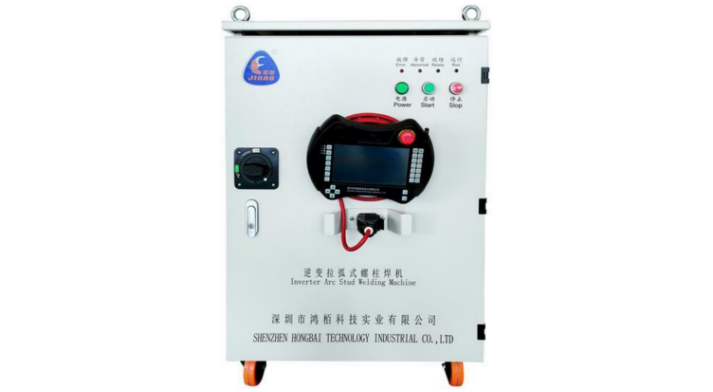
Generation 4 | 2009–Present
DSP + FPGA + CPLD Fully Digital Control
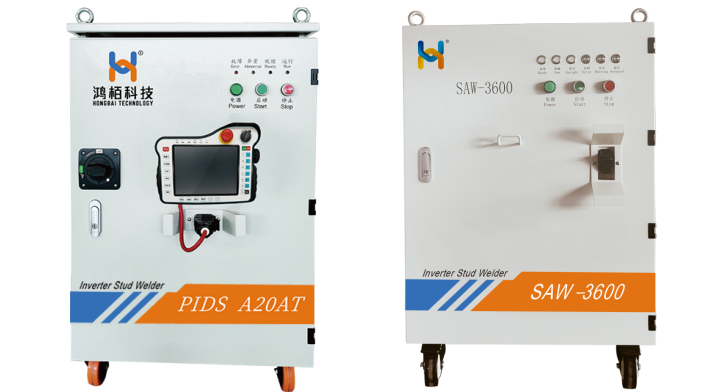
Generation 5 | AI-Based Intelligent Quality Control
Fully Digital Welding Control + AI-Based Quality Prediction and Visual Inspection
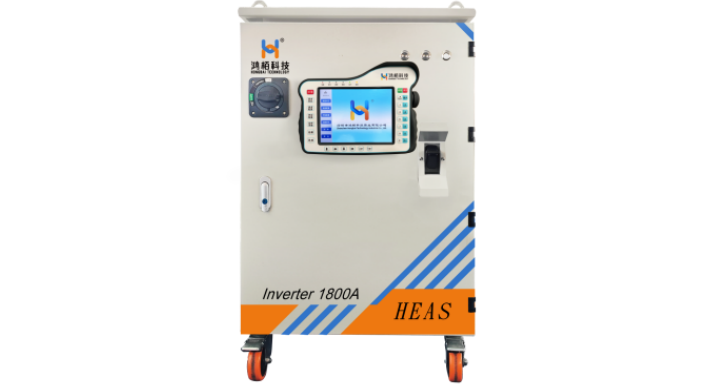
From analog control to fully digital control and then to AI-enabled quality management, the focus of technology development has also evolved.
In the past, the primary objective was:
“How can welding operations be executed with greater precision?”
Today, the focus is expanding toward:
“How can the welding process be understood and weld quality evaluated?”
Built on this technological foundation, HEAS integrates AQC2 active process control with AI-based quality management.
4. How Does AQC2 Actively Resist External Disturbances?
The core of AQC2 is not simply adding more parameters to the welding system. It is about enabling the system to respond more actively to changes occurring throughout the production process.
Within the HEAS system, this capability is supported by several key technologies, including:
- Fully Digital Control Architecture
- Voltage Feedforward Control
- Peak Current Protection
- Linear Servo Motor + 360 LPI Grating Feedback
Each technology addresses a different aspect of the welding process and together they form the technical foundation of AQC2’s active quality control capability.
4.1 Voltage Feedforward: Responding to Line Voltage Changes in Advance
In an actual manufacturing environment, supply voltage is rarely perfectly constant.
Particularly on large automotive production lines, multiple welding systems, robots, and other high-power equipment may operate simultaneously. Changes in electrical load can therefore result in line-voltage fluctuations.
If the system only reacts after the welding process has already been affected, the resulting variation may already have been reflected in the weld.
AQC2 uses voltage feedforward control to detect and compensate for changes in input voltage in advance, reducing the impact of line disturbances and other electrical variations on the welding process.
This illustrates an important difference between active quality control and conventional parameter-based control:
Instead of waiting for a deviation to occur and then correcting it, the system seeks to anticipate and compensate for changes that may affect the welding process.
4.2 Peak Current Protection: Controlling Transient Current
During stud welding, instantaneous current can reach a high level.
If peak current is not properly controlled, it can affect the welding process while also increasing the electrical stress placed on power electronic components and the main transformer.
HEAS uses a peak current protection mechanism to control transient current during welding, reducing the impact of abnormal current peaks on power components and the main transformer.
Therefore, this technology contributes not only to current stability during welding, but also to the long-term operating stability of the equipment during continuous production.
4.3 Linear Servo Motor + 360 LPI Grating Feedback: Precise Control of the Welding Motion
In drawn arc stud welding, stud lift height and arc gap directly influence the arc condition and the subsequent welding process.
If the lift distance deviates from the target value, the actual welding condition may change even when weld current and weld time remain unchanged.
HEAS uses a linear servo motor drive combined with 360 LPI grating feedback to precisely control stud lift motion.
This means the system is not only controlling:
What is the weld current?
What is the weld time?
It is also controlling:
How far has the stud actually lifted?
Is the arc gap accurate?
Is the motion being executed as intended?
Welding control therefore extends beyond conventional electrical parameter control into precise control of the welding motion itself.
This is also an important foundation for AQC2 to maintain consistent welding performance.
5. AQC2 Stabilizes the Process; AI Takes Quality Evaluation Further
At this point, the relationship between AQC2 and AI becomes clear.
They are not two unrelated functions, nor are they simply “welding” and “visual inspection” combined in the same system.
AQC2 focuses on the welding process.
It actively controls the process to reduce the impact of external disturbances.
AI focuses on weld quality.
It seeks to answer questions such as:
What happened during this weld?
Was the final weld result acceptable?
Is there a potential quality abnormality?
In simple terms:
AQC2 controls the process.
AI predicts and inspects quality.
Data connects the process with the result.
Together, these three elements enable HEAS to move from process control alone toward intelligent quality management.
6. AI-Based Quality Inspection Is More Than Taking a Picture After Welding
Traditional AI-based visual inspection typically takes place after welding.
An industrial camera captures an image of the weld, and a deep-learning model analyzes the image to determine whether defects are present.
This type of post-weld visual inspection is important. However, if quality management stops there, the basic approach remains:
“Complete the weld first, then evaluate the result.”
The AI-based quality management approach implemented with HEAS can extend further into the welding process itself.
It includes two key aspects:
AI-based quality prediction during welding and AI-based visual inspection after welding.
7. AI-Based Quality Prediction During Welding: Identifying Abnormal Trends Before the Weld Is Complete
Electrical signals such as welding current and voltage change with the welding condition.
These signals are more than simple equipment operating parameters. They contain a significant amount of information about what is happening during the welding process.
By collecting welding current, voltage, and other process data in real time and analyzing them with AI models, the system can evaluate the current welding state and predict potential quality abnormalities.
This means quality evaluation can begin to move from:
After the weld is completed
to:
While the weld is in progress
For millisecond-scale stud welding, this process data is particularly valuable.
It helps establish the relationship between welding process conditions and weld quality outcomes, enabling the system to move beyond simply executing welding operations toward developing the capability to understand the welding process.
8. Post-Weld AI Visual Inspection: Verifying Weld Quality Through the Final Result
Process data can indicate what happened during welding, but the final weld still needs to be verified based on the actual result.
After welding, an industrial camera captures high-resolution images of the weld.
The AI vision system then uses a deep-learning model to identify and analyze the weld appearance.
Depending on the application, the system can identify typical welding defects including:
- Lack of fusion
- Porosity
- Cracks
- Stud misalignment
- False welds
- Excessive weld buildup
- Spatter
- Burn-through
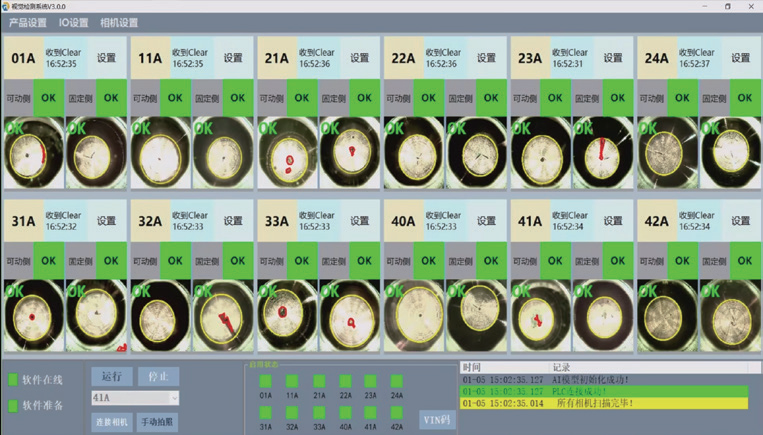
Compared with conventional manual visual inspection, AI-based visual inspection converts weld images into analyzable and traceable data, moving quality evaluation from experience-dependent visual inspection toward a more standardized and digital approach.
But the real value of AI visual inspection is not simply telling an engineer:
“This weld is NG.”
The more important questions are:
“Why is it NG?”
and:
“Is this abnormality becoming a trend?”
This allows visual inspection results to become part of the broader quality feedback and process analysis loop.
9. HEAS + AQC2 + AI: From Detecting Problems to Resolving Them
AQC2 alone can actively control the welding process, but it cannot independently determine the final weld quality.
AI visual inspection alone can identify problems in the final weld, but those problems have already occurred by the time they are detected.
HEAS therefore connects AQC2 with AI-based quality prediction, AI visual inspection, and welding process data to establish a more complete quality control chain.
The overall process can be understood as:
AQC2 actively controls the welding process
↓
Stud welding is performed
↓
Welding current, voltage, and other process data are collected in real time
↓
AI performs weld quality prediction
↓
Welding is completed
↓
Industrial camera captures the weld image
↓
AI visual inspection is performed
↓
Quality evaluation and abnormality identification
↓
Quality data feedback
↓
Abnormality root-cause identification
↓
Welding process optimization
↓
The optimized process is applied to subsequent welding operations
Ultimately, this creates a continuous loop:
Process Control → Real-Time Prediction → Result Inspection → Quality Feedback → Process Optimization → Re-Control
In other words:
Detect → Feedback → Locate → Correct → Resolve
This is the key difference between an intelligent closed-loop quality management approach and conventional post-weld inspection.
10. Why Is “Control + Prediction + Inspection” Better Suited to High-Volume Production?
In high-volume manufacturing, the most serious problem is not necessarily an occasional NG weld.
The real concern is:
Whether an abnormal condition is continuing to occur.
For example, on an automotive body-in-white production line, if line voltage changes, workpiece surface conditions vary, or the welding gun experiences a motion deviation while the equipment continues operating with fixed parameters, the resulting variation may affect dozens, hundreds, or even more welds.
With conventional sampling inspection, the problem may not be discovered until the next inspection point.
The HEAS approach is designed to move quality control upstream as much as possible:
AQC2 controls the process;
AI analyzes process data for quality prediction;
post-weld AI visual inspection verifies the final result;
quality data is then fed back into process analysis.
Quality management therefore goes beyond simply:
Detecting NG welds.
It becomes:
Identify abnormal trends → Locate the cause → Optimize the process → Re-apply process control.
This is particularly valuable in high-cycle, highly repetitive manufacturing environments such as automotive body-in-white production.
11. Data Traceability: Making Every Weld Traceable
As welding processes become digitalized, welding data itself becomes part of quality management.
HEAS can record, monitor, and analyze relevant welding process data, including welding current, voltage, power, and other process information.
When an individual weld is identified as abnormal, engineers are no longer limited to asking:
“Why is this weld NG?”
They can also trace:
What were the welding parameters at that time?
Did the welding current change?
Was the voltage condition abnormal?
Did any fluctuation occur during welding?
Did similar abnormalities occur during the same period?
An isolated NG weld can therefore be further reconstructed as a process-related issue that can be analyzed.
This is one of the important advantages of an intelligent welding system:
Weld quality is no longer just an outcome. It becomes a set of data that can be traced, analyzed, and optimized.
12. The Real Test for HEAS Is Not the First Stud—It Is the 10,000th
A single successful stud weld only proves that one welding operation was successful.
The real test of an intelligent stud welding system is whether it can maintain consistent performance after continuously producing 10,000 welds or more.
Does the welding condition remain consistent from the first weld to the last?
Can the equipment maintain stable performance across different shifts and production periods?
When workpiece conditions change, can the welding process resist external disturbances?
When an abnormality occurs, can the system identify it in time?
Once an abnormality is identified, can its cause be further located?
After the process is optimized, can the improved process be applied to subsequent production?
These questions determine whether a welding system is simply capable of performing a weld, or whether it has the intelligent quality control capability required for high-volume manufacturing.
13. From AQC2 to AI: How HEAS Is Advancing Stud Weld Quality Control
The evolution of stud welding technology is, in essence, also an evolution in the way weld quality is controlled.
From analog control to microcontroller-based systems, and then to DSP, FPGA, and CPLD-based fully digital control, welding equipment has become increasingly capable of executing welding operations with greater precision.
AQC2 takes this a step further by enabling the system to actively respond to external disturbances during welding.
The introduction of AI further gives the system the ability to predict and evaluate weld quality.
Therefore, within the HEAS intelligent stud welding system:
The fully digital control architecture provides the underlying control capability;
AQC2 actively controls the welding process;
AI-based quality prediction analyzes process data during welding;
AI visual inspection verifies the final weld result;
Data traceability and feedback connect the process with the result.
Together, they create a complete quality control logic:
Control the Process → Predict Quality → Inspect the Result → Feed Back Abnormalities → Optimize the Process
The conventional approach:
Set Parameters → Perform Welding → Inspect After Welding
is evolving toward:
Active Control → Real-Time Prediction → Result Inspection → Data Feedback → Process Optimization
This means stud weld quality management is moving from a model based primarily on result inspection toward a more comprehensive approach that combines process control with result verification.
Because in true high-volume manufacturing:
A good weld on one stud is a successful weld.
Consistently good welds across 10,000 studs are a measure of true manufacturing capability.
And that is what the HEAS AQC2 + AI quality management architecture is designed to achieve: making weld consistency not simply an occasional result, but a manufacturing capability that can be controlled, predicted, inspected, traced, and continuously optimized.
Want to learn how HEAS, AQC2 and AI-based quality control can be applied to your stud welding process? Contact Hongbai Technology or follow us on LinkedIn for more welding technology insights and application updates.