


In resistance spot welding, a stable weld is not simply a matter of setting the correct current. The result depends on how welding current, electrode force, and weld time interact throughout the welding cycle.
This becomes particularly important in automotive manufacturing, where a single production line may handle different sheet thicknesses, galvanized steels, and high-strength materials. A welding schedule that performs well on one material combination may produce excessive spatter or insufficient weld nugget formation on another.
Increasing the current is not always the answer. Nor does applying more electrode force necessarily improve the weld. What matters is maintaining the right relationship between electrical heat generation and the mechanical conditions at the joint.
This is the principle behind dual-loop control in resistance spot welding. By regulating welding current and electrode force through coordinated feedback control, the system can respond more effectively to process variations and help maintain consistent welding performance.
How Dual-Loop Control Works
Dual-loop control refers to two feedback control functions operating within the welding system: closed-loop welding current control and weld force control. Although they serve different purposes, both influence the conditions under which the weld nugget forms.
| Control function | Feedback or monitoring variable | Control mechanism | Primary objective |
|---|---|---|---|
| Welding current control | Actual welding current | Inverter output regulation | Maintain the commanded current despite electrical load variations |
| Weld force control | Electrode force, where sensor feedback is available | Pneumatic proportional valve or electric servo actuator | Regulate electrode force and monitor force-related process conditions |
| Adaptive coordination | Application-specific process feedback and programmed welding schedules | Control logic and parameter adjustment | Match welding conditions to qualified material and joint requirements |
The current control loop monitors the actual welding current and compares it with the programmed target. The controller adjusts the inverter output to reduce deviations, helping maintain the required current as electrical conditions change.
The force control loop regulates electrode force through a servo mechanism and, where equipped, monitors the actual force using sensor feedback. This helps maintain the intended mechanical conditions during electrode contact and welding.
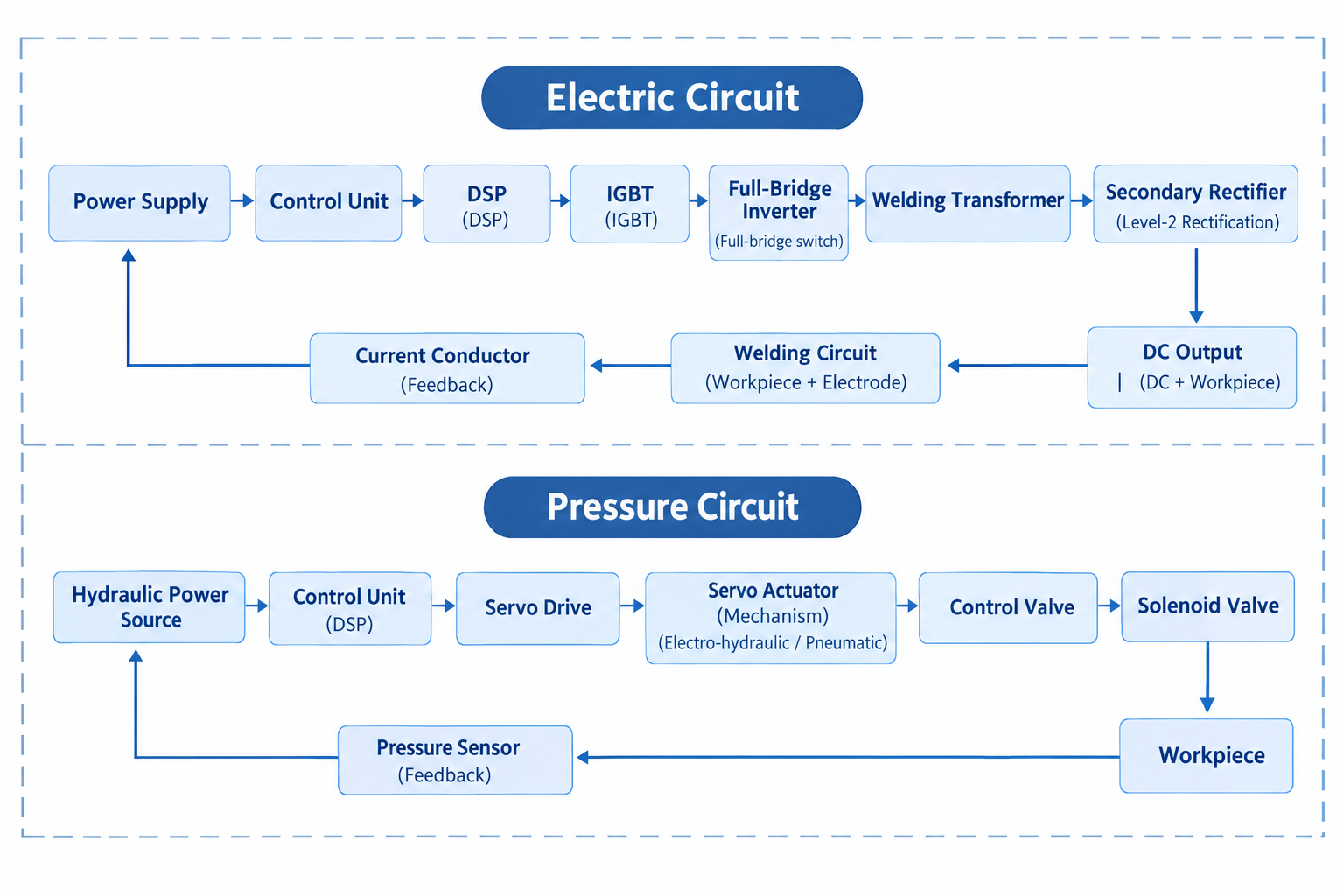
Stable resistance spot welding depends on coordinated control of welding current, electrode force, and welding time.
Neither loop replaces the other. Stable current cannot compensate for an unsuitable electrode force, just as accurate force control cannot make up for an inadequate welding schedule.
The challenge is to coordinate both variables according to the materials, joint configuration, and required welding conditions.
Why Current Control Alone Is Not Enough
Resistance spot welding generates heat as current passes through the resistance of the workpiece and its contact interfaces. The amount and distribution of heat influence the formation and growth of the weld nugget.
In practice, however, the electrical resistance of a joint is not constant. Surface coatings, electrode wear, contact conditions, and material combinations can all affect the welding process.
When heat input becomes excessive for the prevailing conditions, molten metal may be expelled from the joint. This expulsion, commonly referred to as weld spatter, can contaminate electrodes, increase cleaning requirements, and affect production stability. At the other extreme, insufficient heat input may result in an undersized weld nugget or inadequate joint strength.
Closed-loop current control helps the power source maintain the commanded current more consistently. Hongbai’s inverter resistance spot welding systems combine digital control with current feedback to regulate electrical output as operating conditions change.
This is particularly valuable in automated production, where repeatability matters more than achieving a satisfactory result on a single weld.
However, current regulation alone does not guarantee weld quality. The current target, welding time, electrode force, and material-specific process window must still be established through appropriate welding trials and validation.
Electrode Force: The Other Half of the Process
Electrode force affects the contact conditions between the electrodes and workpieces, influencing current density, contact resistance, and the development of the weld nugget.
If the force is too low for the selected welding schedule, localized heating and expulsion may become more likely. If it is too high, the resulting contact conditions may reduce resistance heating and make nugget formation more difficult under otherwise unchanged settings.
This is why force should not be treated as a fixed mechanical setting that can be ignored once the welding gun has been installed.
Hongbai provides pneumatic servo and electric servo solutions for different resistance spot welding configurations. Proportional-valve-controlled pneumatic systems support force regulation in applicable high-frequency systems, while electric servo actuators provide programmable force control and monitoring in medium-frequency and aluminum-joining configurations.
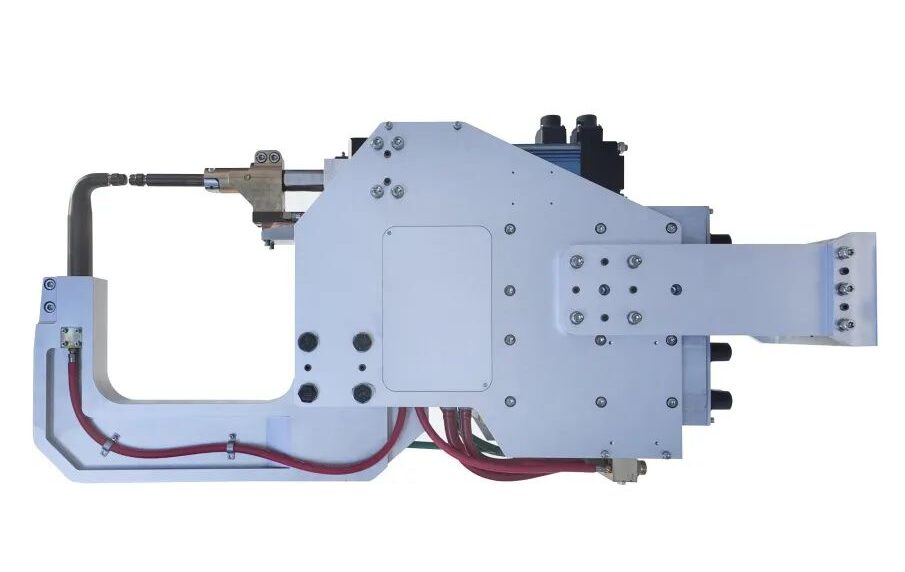
Controlled electrode force helps maintain stable contact conditions throughout the welding cycle.
For applicable electric servo systems, electrode force can exceed 900 kg, depending on the configuration. The practical advantage is not simply the ability to apply greater force. It is the ability to regulate force according to the requirements of the welding process and monitor whether the system is operating as intended.
From Dual-Loop Control to Adaptive Welding
Feedback control and adaptive control are related, but they are not the same thing.
A closed-loop controller corrects deviations in a controlled variable, such as welding current. An adaptive strategy goes further by adjusting the welding settings or control strategy in response to relevant changes in process conditions, within defined operating limits.
For example, a production line may need to weld different sheet thicknesses or material combinations at the same station. These combinations can require different welding schedules because their electrical and thermal characteristics are not identical.
| Production condition | Control consideration | Intended process benefit |
|---|---|---|
| Different sheet thicknesses | Select a qualified current-force-time schedule for each material stack-up | More consistent weld formation across product variants |
| Galvanized steel | Balance heat input, electrode force, and coating-related process effects | Reduce the risk of expulsion and improve process stability |
| High-strength steel | Maintain suitable welding conditions for the specific steel grade and joint | Support repeatable nugget formation |
| Changes in electrical load | Use current feedback to regulate actual output | Reduce sensitivity to electrical load variations |
| Mixed-model production | Apply validated schedules and appropriate force settings | Reduce repeated manual adjustment during changeovers |
With an appropriately configured adaptive control system, current and force settings can be coordinated with the selected welding schedule to suit the specific application. This can reduce the need for repeated manual adjustments when changing between qualified production conditions.
The distinction matters: adaptive control does not mean that a machine can automatically weld any material combination without prior setup. Reliable results still depend on suitable parameter windows, process qualification, electrode condition, and the capabilities of the control system.
When these requirements are addressed, dual-loop control provides a stronger foundation for flexible production, particularly in automotive body manufacturing, where several material grades and thicknesses may be used within the same assembly.
Hongbai’s Resistance Spot Welding Technology
Hongbai applies inverter power technology, digital control, and servo actuation across different resistance spot welding solutions. The choice of system depends on the required output, force-control method, material characteristics, and production conditions.
| System series | Main technology | Force-control configuration | Typical application focus |
|---|---|---|---|
| SHF high-frequency inverter DC | 10 kHz inverter technology, full-bridge soft switching, DSP-based digital control | Pneumatic servo with proportional-valve control | Applications requiring flexible force regulation across different material conditions |
| MF medium-frequency inverter DC | Full-digital power supply, high-speed DSP control, closed-loop current regulation, secondary rectification | Electric servo actuator with programmable force control and monitoring | Automotive body welding and demanding production applications |
| High-power medium-frequency aluminum-joining system | 1 kHz or 2 kHz welding transformer configurations, high-power output | Electric servo force control and monitoring, depending on configuration | Aluminum resistance spot welding and other high-current joining applications |
The SHF high-frequency inverter DC system combines 10 kHz inverter technology, full-bridge soft switching, and DSP-based digital control. Its pneumatic servo configuration supports force regulation and adaptive welding applications requiring flexibility across different material conditions.
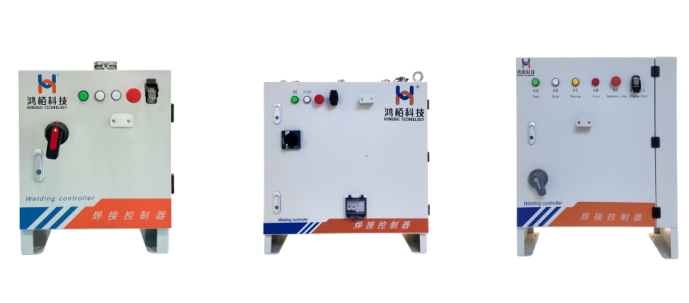
Different resistance spot welding configurations address different material, force, and production requirements.
The MF medium-frequency inverter DC system combines a full-digital power supply, high-speed DSP control, closed-loop current regulation, and secondary rectification. With electric servo actuation, it supports programmable electrode force and real-time force monitoring in applicable configurations. Electrode force can exceed 900 kg, depending on the system design.
For aluminum joining, Hongbai also offers high-power medium-frequency systems designed for the demanding electrical and thermal requirements of aluminum resistance spot welding. Depending on the configuration, these systems can deliver welding currents of up to 60,000 A and support single- or dual-transformer arrangements.
Each configuration addresses a different set of production requirements. Selection should be based on material type, sheet stack-up, joint geometry, electrode design, required cycle time, and the available welding process window.
What Manufacturers Gain from Better Coordination
The value of dual-loop control becomes clear when it is considered in the context of daily production.
More stable current and force conditions can help reduce variations in weld formation and lower the risk of spatter. Reduced spatter may also mean less electrode cleaning, fewer interruptions, and less downstream rework.
For manufacturers running multiple vehicle models or material combinations, programmable servo force and qualified welding schedules can make production changeovers more manageable. Current feedback and force monitoring also provide useful information for troubleshooting when the welding process begins to drift.
These benefits are connected. Better process control can support better weld consistency, while improved consistency can reduce the time and resources spent correcting defects.
The actual improvement depends on the application and must be verified through welding tests and production data. Dual-loop control is not a substitute for proper electrode maintenance, joint preparation, or quality assurance; it is a way to manage important process variables more precisely.
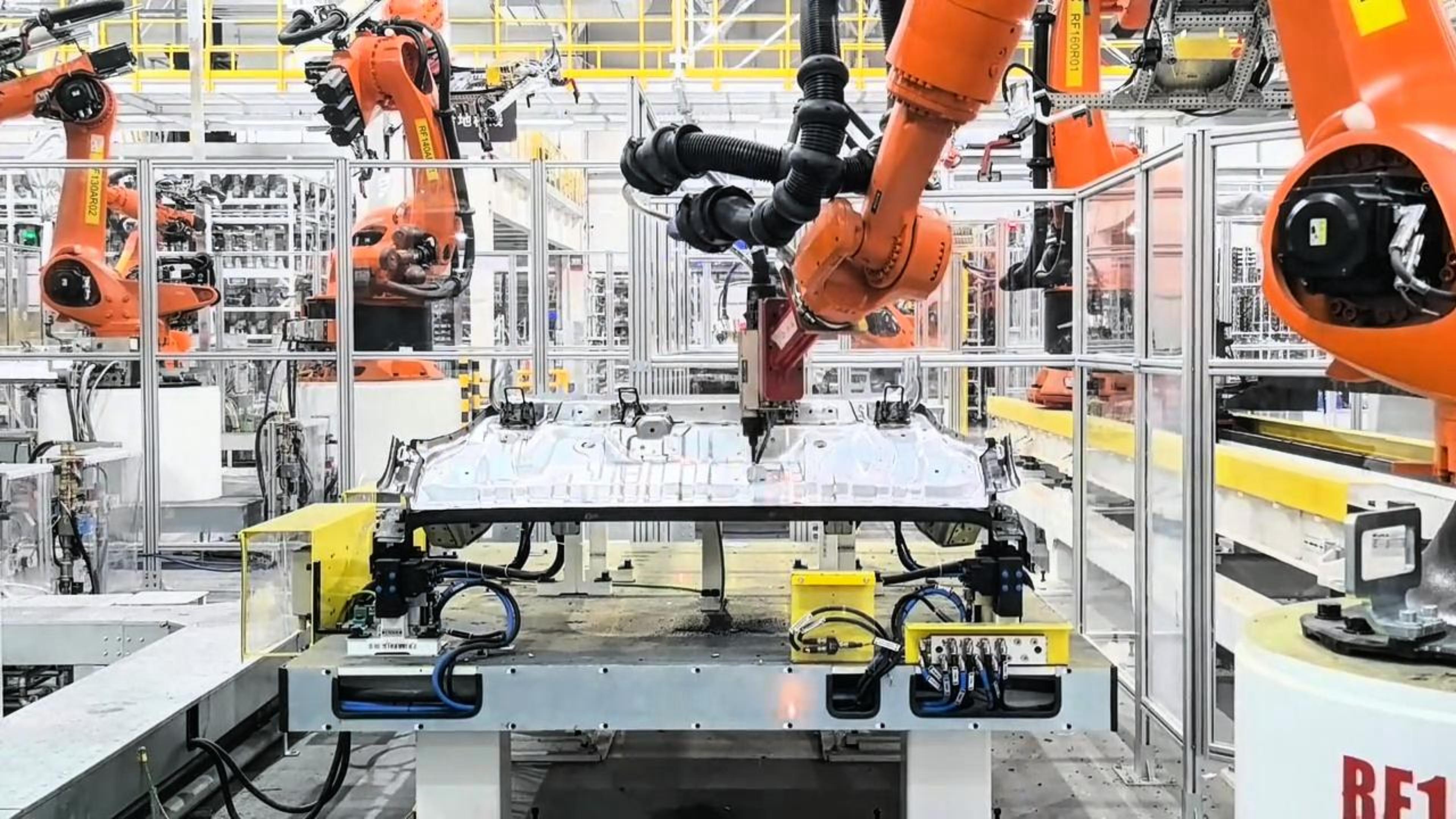
Coordinated process control can help manufacturers improve weld consistency and manage production variation.
A More Controlled Approach to Resistance Spot Welding
As automotive structures incorporate more high-strength steel, galvanized sheet, and aluminum, maintaining a stable resistance spot welding process becomes increasingly demanding.
The answer is not simply to increase welding current or electrode force. It is to understand how these variables interact and control them accordingly.
By combining closed-loop current regulation with servo-based force control and application-specific adaptive strategies, Hongbai Technology helps manufacturers build more stable and flexible resistance spot welding processes.
For production engineers and automation teams, the key question is not just whether a welding system can deliver the required current or force. It is whether the system can maintain the right conditions throughout the welding cycle and across the demands of real production.
Hongbai Technology develops resistance spot welding solutions for automotive manufacturing and other industrial applications. Contact our team to discuss your materials, welding requirements, and process integration needs.