Understanding the relationship between lift height, arc voltage, welding energy, and equipment settings.
1. What Is Lift Height in Drawn Arc Stud Welding?
Lift height is a key process parameter in drawn arc stud welding. It refers to the distance the welding gun lifts the stud from the workpiece at the beginning of the welding current stage.
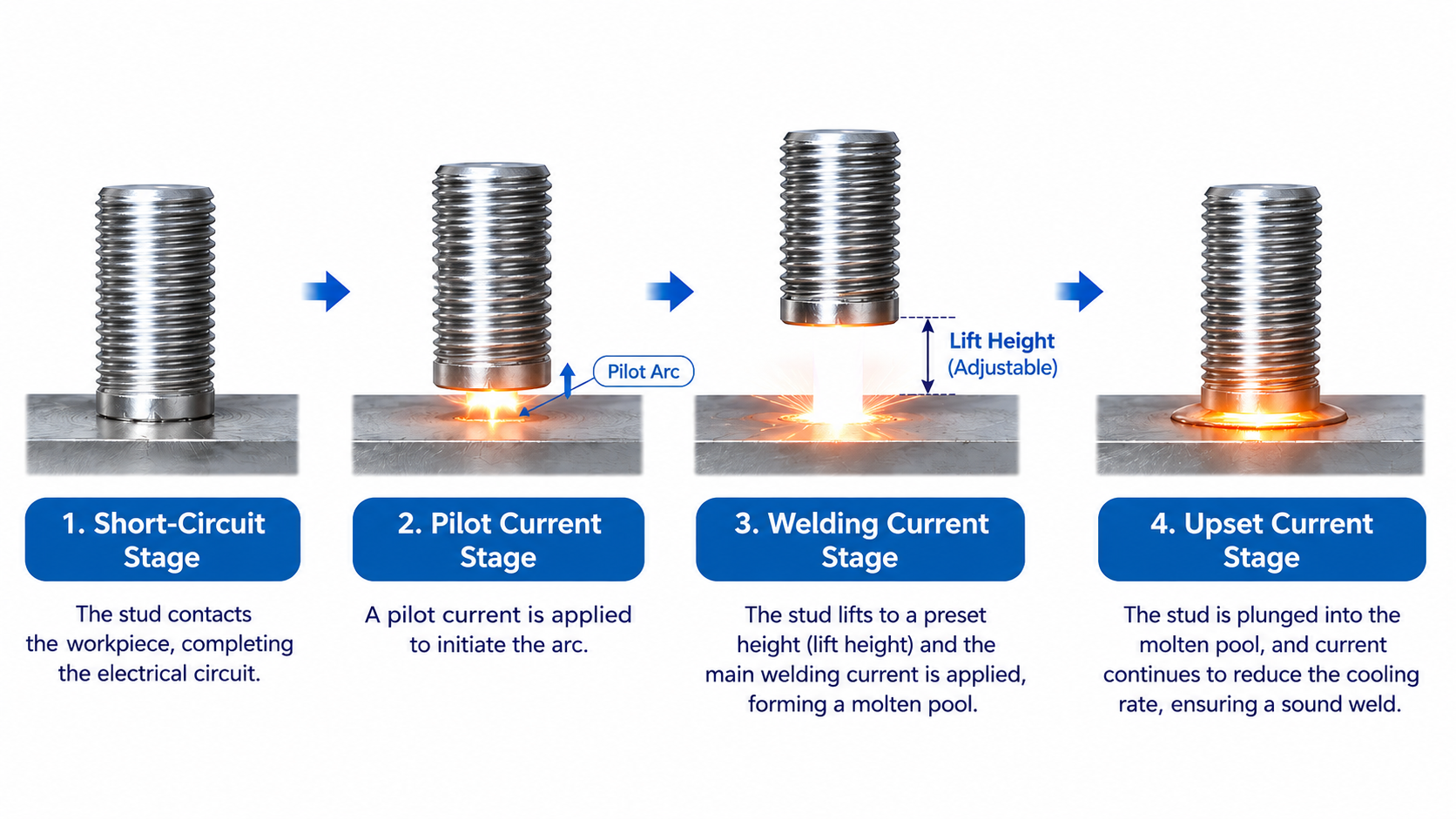
The drawn arc stud welding process consists of four stages:
- Short-Circuit Stage – The stud contacts the workpiece, completing the electrical circuit.
- Pilot Current Stage – A pilot current is applied to initiate the arc.
- Welding Current Stage – At the beginning of this stage, the welding gun lifts the stud to a preset distance from the workpiece. This distance is the lift height. The main welding current then maintains the arc and melts the stud end and the corresponding area of the workpiece.
- Upset Current Stage – The stud is plunged into the molten pool. The power source continues to apply current to the workpiece, reducing the cooling rate and helping maintain the plasticity of the joint to form a sound and reliable connection.
Lift height is therefore more than a mechanical position setting. It directly affects the arc voltage during welding and, consequently, the energy delivered to the joint.
2. How Does Lift Height Affect Arc Voltage and Welding Energy?
In drawn arc stud welding, lift height directly influences the arc voltage.
According to the SAW3600R series technical documentation, increasing the lift height raises the arc voltage. When welding current and welding time remain unchanged, a higher arc voltage results in greater energy input.
This relationship can be understood through Joule’s law: the electrical energy converted into heat depends on current, arc resistance, and the duration of current flow. Arc voltage reflects the arc resistance in the welding circuit and is therefore an important factor affecting energy output.
For the relevant Hongbai equipment models, actual arc voltage is an important process parameter and a key factor in welding quality control. The expected arc voltage reference of 20–26 V is specified in the technical documentation for the relevant model. This range should be applied according to the corresponding equipment requirements rather than treated as a universal value for all models.
3. Why Is the Expected Arc Voltage a Passive Parameter?
The expected arc voltage is a reference value used by the welding system. The actual arc voltage is primarily determined by the lift height during the welding process.
The two parameters are therefore not set independently of each other. Lift height is set first, and the actual arc voltage follows from the resulting arc condition.
The system measures the actual arc voltage and uses it as a basis for monitoring and compensation. It does not independently establish the arc voltage regardless of the mechanical lift height.
In practical terms, arc voltage is the resulting value, while lift height is the parameter that directly determines it. Arc voltage records can therefore provide a measured indication of how the lift-height setting performs during individual welds.
4. Why Is 1.0–1.5 mm Commonly Recommended?
A lift height of 1.0–1.5 mm is commonly used as a reference setting for several drawn arc stud welding systems.
This range provides a practical starting point for setting up the welding process. However, the appropriate value depends on the equipment model and the actual welding conditions. The reference range should not be treated as a universal setting for every machine or application.
For thin-sheet applications, reducing arc voltage is beneficial. For T-type studs welded onto approximately 0.6 mm sheet, a lift-height reference of 0.6–1.0 mm may be used.
The equipment-specific ranges and reference values are listed in Section 6.
5. Lift Height and Plunge Depth: Two Different Parameters
Lift height and plunge depth are two separate process parameters. They act at different points in the welding process and serve different purposes.
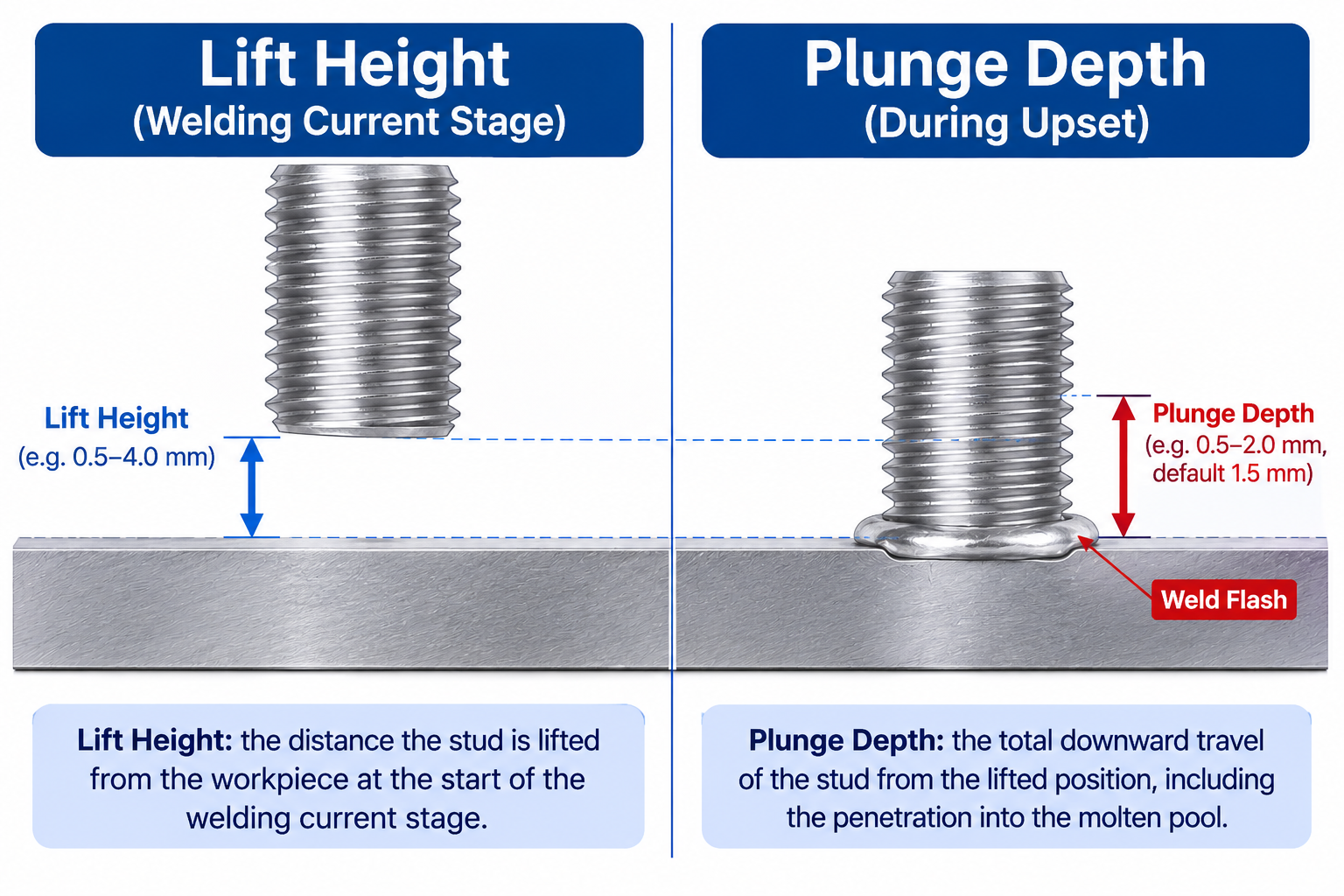
Lift Height (Pos1)
Lift height determines how far the stud is lifted from the workpiece at the beginning of the welding current stage. It affects the arc voltage and, in turn, the energy delivered during welding.
Plunge Depth (Pos3)
Plunge depth determines how far the stud is plunged into the workpiece during the upset stage.
An excessively high Pos3 setting causes the stud to contact the base material too quickly and strike into the molten pool, resulting in increased spatter.
If Pos3 is set too low, the stud remains floating above the base material, which can result in a cold weld.
Lift height and plunge depth must therefore be considered separately when setting and evaluating the welding process.
6. Lift Height Parameters for Different Hongbai Equipment Models
Lift-height ranges and reference settings vary by equipment model. The following values are based on the technical documentation for the relevant model.
| Equipment Model | Lift-Height Range | Reference / Default Setting |
|---|---|---|
| SAW3600 Series | 0.7–4.0 mm | 1.0–1.5 mm |
| SAW3600C | 0.5–4.0 mm | 1.0 mm |
| PIDS | 0.2–3.0 mm | 1.2 mm |
| HEAS | 0.5–4.0 mm | 1.0–1.5 mm |
For the HEAS system, Pos1 is displayed in millimetres, with a setting precision of 0.01 mm.
The return distance of an electromagnetic welding gun is a separate parameter, with a reference range of 0.5–1.2 mm. It should not be confused with the dynamic lift height during welding.
7. Arc Voltage Deviation Compensation
Some Hongbai welding systems provide arc voltage deviation compensation.
The system determines whether the actual arc voltage falls within the specified deviation from the expected arc voltage. When the deviation exceeds the set range, the system automatically compensates the welding current to maintain the output energy as far as possible.
The relevant settings are as follows:
| Parameter | Default Value | Setting Range |
|---|---|---|
| Arc Voltage Deviation | 1.0 V | 0.1–2.0 V |
| Current Deviation | 100 A | 10–200 A |
These values are equipment settings. Their availability and applicable ranges should be checked against the technical documentation for the relevant model.
8. Lift Height Must Match the Equipment and Welding Conditions
Lift height is the first control point in this energy relationship — the arc voltage and energy input that follow are directly related to this setting.
The 1.0–1.5 mm range is a useful reference for many applications, but the final setting must be selected according to the equipment model and the actual welding conditions.
When evaluating a welding process, lift height, actual arc voltage, welding current, welding time, and plunge depth should be considered in their respective roles. Equipment-specific documentation should always take precedence over general reference values.
Hongbai manufactures drawn arc stud welding equipment and control systems for automotive manufacturing, general mechanical manufacturing, shipbuilding, and structural and civil engineering applications.